Listed below are important links to setup instructions for connecting an Asus Merlin firmware router to the internet and WiFi.
Search Results for: wifi setup
Asus RT-AC68U B1 / C1 / AC1900 DD-WRT WiFi Settings
Recommended DD-WRT WiFi settings for the Asus RT-AC68U are based on extensive testing by FlashRouters. Please note that optimal settings may vary depending on external factors such as home size, interference, and the types of WiFi devices you are connecting in your network.
Screenshots below provide a visual display of recommended WiFi and encryption settings exactly as they appear in the Asus RT-AC68U with DD-WRT firmware.
Navigate to the Wireless > Basic Settings to view or edit WiFi network settings.
2.4 GHz - Wireless-N

5.0 GHz - Wireless-AC

Additional DD-WRT WiFi Information
Intimidated by all the available WiFi settings? The DD-WRT website provides extensive information about all of the available configuration options in the firmware. Learn about everything from Wireless channels to channel widths and more in the Basic Wireless Settings – DD-WRT Wiki.
RT-AC68U DD-WRT Wireless Security
The preset RT-AC68U FlashRouter WiFi password is Wireless#[First 5 characters of your router MAC]. The router MAC can be found on the bottom of your router. For e.g. if your MAC is 1459C07E70A8 then your WiFi password is Wireless#1459C
Navigate to the Wireless > Wireless Security to view or edit WiFi passwords.

Netgear R6400V2 DD-WRT WiFi Settings
Recommended DD-WRT WiFi settings for the Linksys R6400V2 are based on extensive testing by FlashRouters. Please note that optimal settings may vary depending on external factors such as home size, interference, and the types of WiFi devices you are connecting in your network.
Screenshots below provide a visual display of WiFi settings exactly as they appear in the Linksys R6400V2 with DD-WRT firmware.
Navigate to the Wireless > Basic Settings to view or edit WiFi network settings.
2.4 GHz - Wireless-N

5.0 GHz - Wireless-AC
Additional DD-WRT WiFi Information
Intimidated by all the available WiFi settings? The DD-WRT website provides extensive information about all of the available configuration options in the firmware. Learn about everything from Wireless channels to channel widths and more in the Basic Wireless Settings – DD-WRT Wiki.
R6400V2 DD-WRT Wireless Security
The preset WiFi password is Wireless#[First 5 characters of your router MAC]. The router MAC can be found on the bottom of your router. For e.g. if your MAC is 1459C07E70A8 then your WiFi password is Wireless#1459C
Navigate to the Wireless > Wireless Security to view or edit WiFi passwords.
Netgear R9000 Nighthawk X10 DD-WRT WiFi Settings
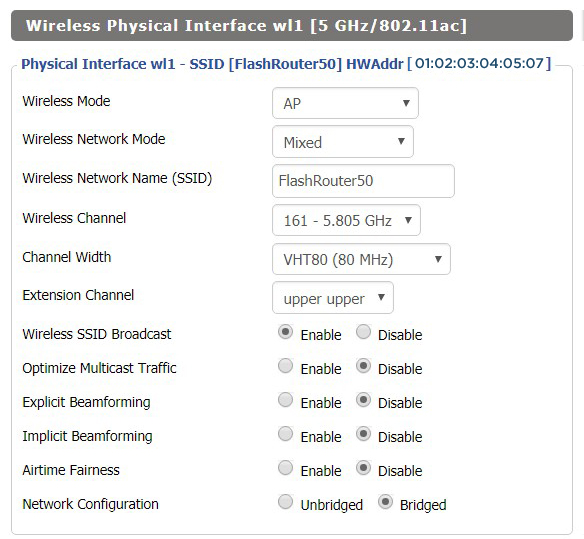
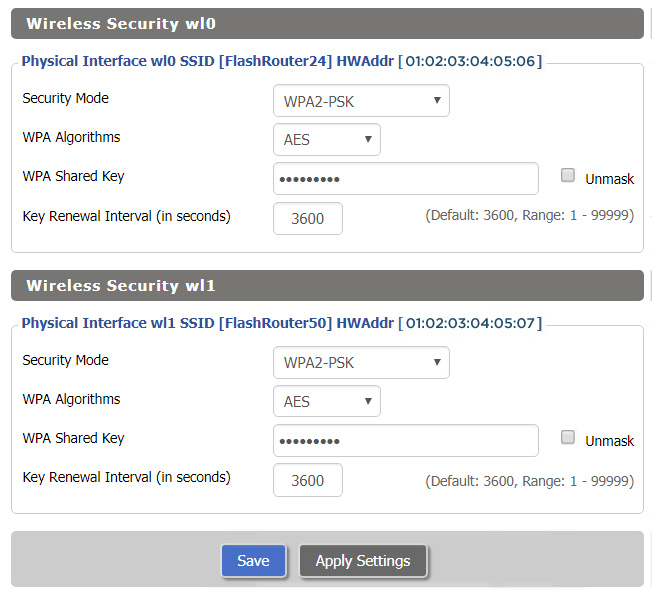
Recommended DD-WRT WiFi settings for the Netgear R9000 are based on extensive testing by FlashRouters. Please note that optimal settings may vary depending on external factors such as home size, interference, and the types of WiFi devices you are connecting in your network.
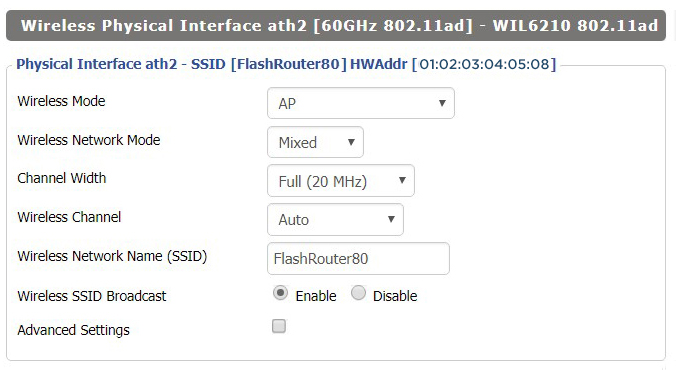
Screenshots below provide a visual display of recommended WiFi and encryption settings exactly as they appear in the Netgear R9000 with DD-WRT firmware.
Navigate to the Wireless > Basic Settings to view or edit WiFi network settings.
5.0 GHz - Wireless-AC
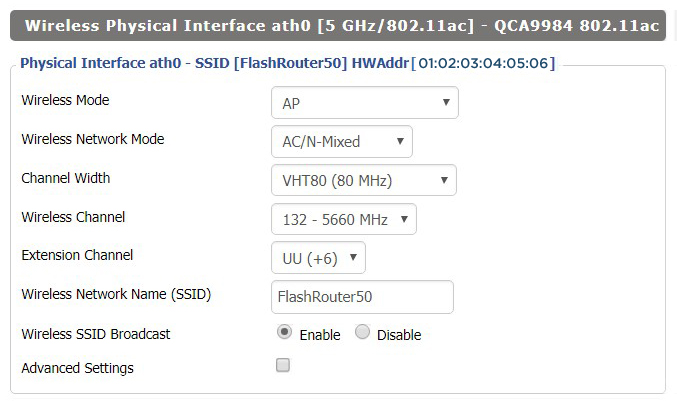
2.4 GHz - Wireless-N
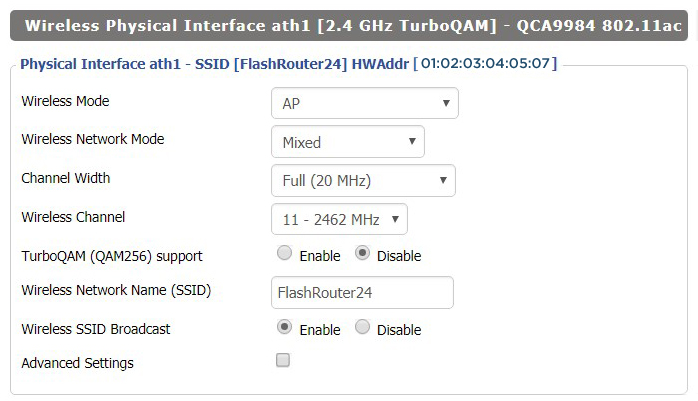
5.0 GHz - Wireless-AD
Additional DD-WRT WiFi Information
Intimidated by all the available WiFi settings? The DD-WRT website provides extensive information about all of the available configuration options in the firmware. Learn about everything from Wireless channels to channel widths and more in the Basic Wireless Settings – DD-WRT Wiki.
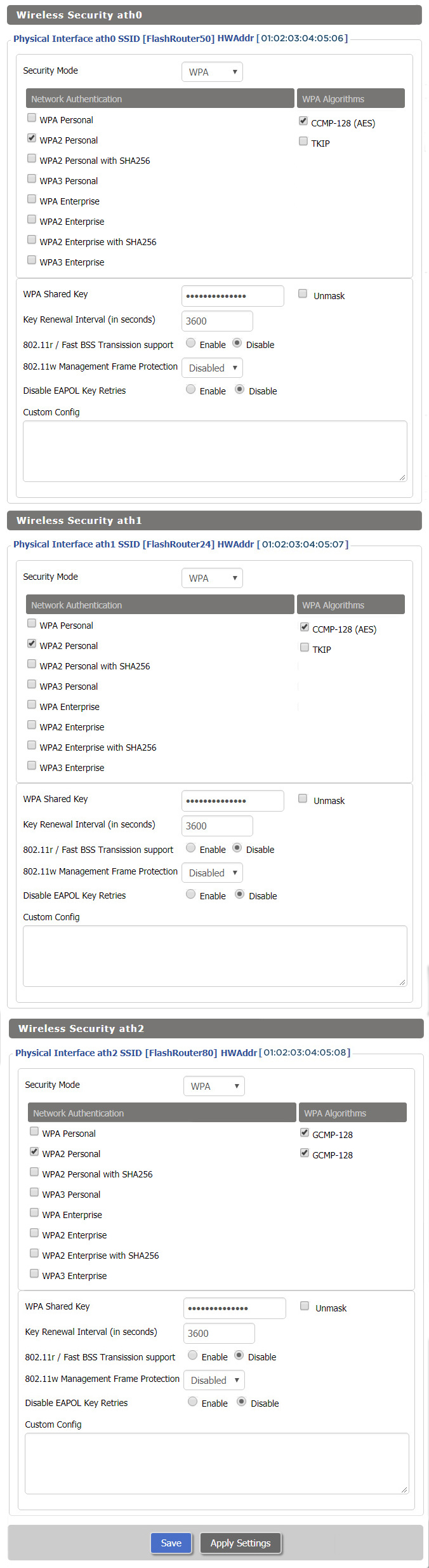
R9000 DD-WRT Wireless Security
The preset R9000 FlashRouter WiFi password is Wireless#[First 5 characters of your router MAC]. The router MAC can be found on the bottom of your router. For e.g. if your MAC is 1459C07E70A8 then your WiFi password is Wireless#1459C
Navigate to the Wireless > Wireless Security to view or edit WiFi passwords.
Linksys WRT1900ACS / ACV2 / ACV1 DD-WRT WiFi Settings
Recommended DD-WRT WiFi settings for the Linksys WRT1900AC are based on extensive testing by FlashRouters. Please note that optimal settings may vary depending on external factors such as home size, interference, and the types of WiFi devices you are connecting in your network.
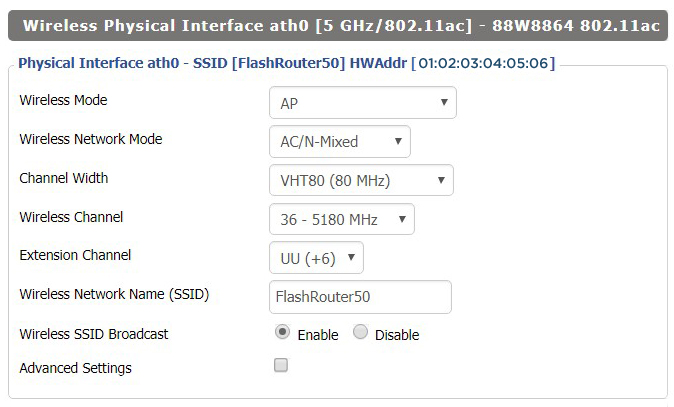
Screenshots below provide a visual display of recommended WiFi and encryption settings exactly as they appear in the Linksys WRT1900AC with DD-WRT firmware.
Please note there are many versions of the WRT1900AC with the same recommended settings, including WRT1900ACv1, WRT1900ACv2, WRT1900ACS, and WRT1900ACSv2.
Navigate to the Wireless > Basic Settings to view or edit WiFi network settings.
5.0 GHz - Wireless-AC
2.4 GHz - Wireless-N

Additional DD-WRT WiFi Information
Intimidated by all the available WiFi settings? The DD-WRT website provides extensive information about all of the available configuration options in the firmware. Learn about everything from Wireless channels to channel widths and more in the Basic Wireless Settings – DD-WRT Wiki.
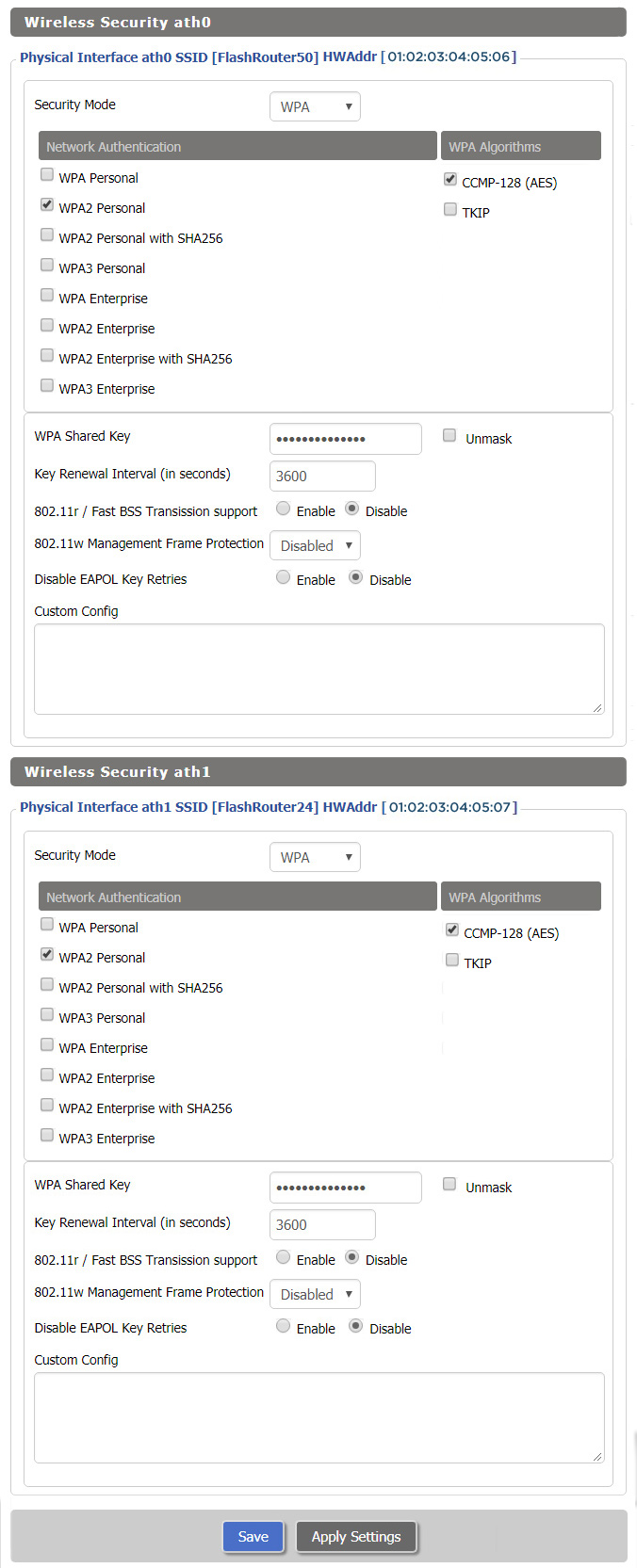
WRT1900AC DD-WRT Wireless Security
The preset WRT1900AC FlashRouter WiFi password is Wireless#[First 5 characters of your router MAC]. The router MAC can be found on the bottom of your router. For e.g. if your MAC is 6038E07E70A8 then your WiFi password is Wireless#6038E
Navigate to the Wireless > Wireless Security to view or edit WiFi passwords.
Netgear R6300V2 DD-WRT WiFi Settings
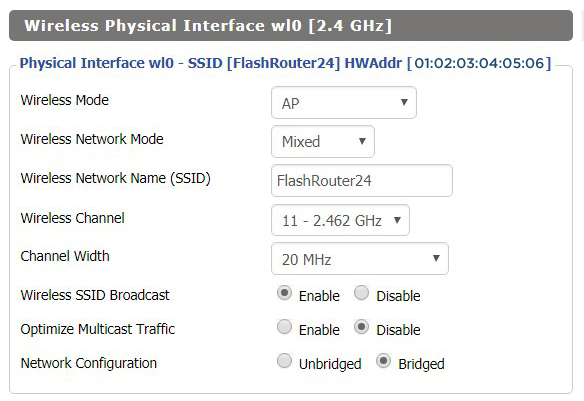
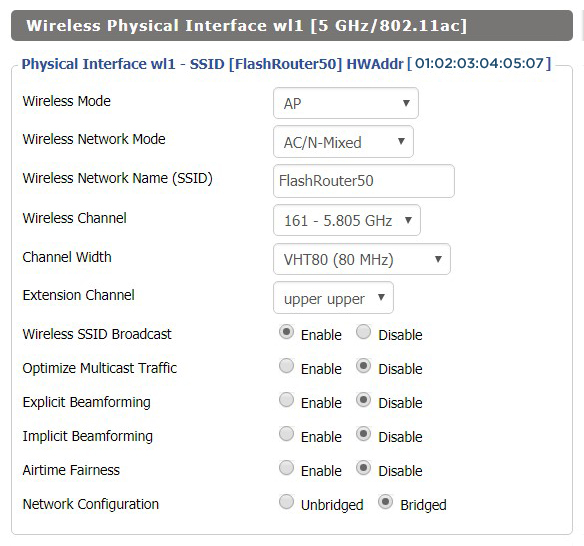
Recommended DD-WRT WiFi settings for the Netgear R6300V2 are based on extensive testing by FlashRouters. Please note that optimal settings may vary depending on external factors such as home size, interference, and the types of WiFi devices you are connecting in your network.
Screenshots below provide a visual display of recommended WiFi and encryption settings exactly as they appear in the Netgear R6300V2 with DD-WRT firmware.
Navigate to the Wireless > Basic Settings to view or edit WiFi network settings.
2.4 GHz - Wireless-N
5.0 GHz - Wireless-AC
Additional DD-WRT WiFi Information
Intimidated by all the available WiFi settings? The DD-WRT website provides extensive information about all of the available configuration options in the firmware. Learn about everything from Wireless channels to channel widths and more in the Basic Wireless Settings – DD-WRT Wiki.
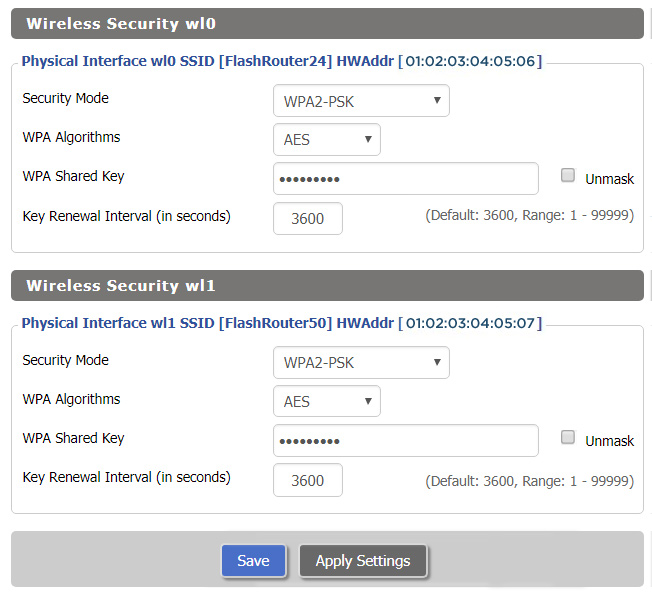
R6300V2 DD-WRT Wireless Security
The preset R6300V2 FlashRouter WiFi password is Wireless#[First 5 characters of your router MAC]. The router MAC can be found on the bottom of your router. For e.g. if your MAC is 1459C07E70A8 then your WiFi password is Wireless#1459C
Navigate to the Wireless > Wireless Security to view or edit WiFi passwords.
Netgear R7800 Nighthawk X4S DD-WRT WiFi Settings
Recommended DD-WRT WiFi settings for the Netgear R7800 are based on extensive testing by FlashRouters. Please note that optimal settings may vary depending on external factors such as home size, interference, and the types of WiFi devices you are connecting in your network.
Screenshots below provide a visual display of recommended WiFi and encryption settings exactly as they appear in the Netgear R7800 with DD-WRT firmware.
Navigate to the Wireless > Basic Settings to view or edit WiFi network settings.
5.0 GHz - Wireless-AC

2.4 GHz - Wireless-N

Additional DD-WRT WiFi Information
Intimidated by all the available WiFi settings? The DD-WRT website provides extensive information about all of the available configuration options in the firmware. Learn about everything from Wireless channels to channel widths and more in the Basic Wireless Settings – DD-WRT Wiki.
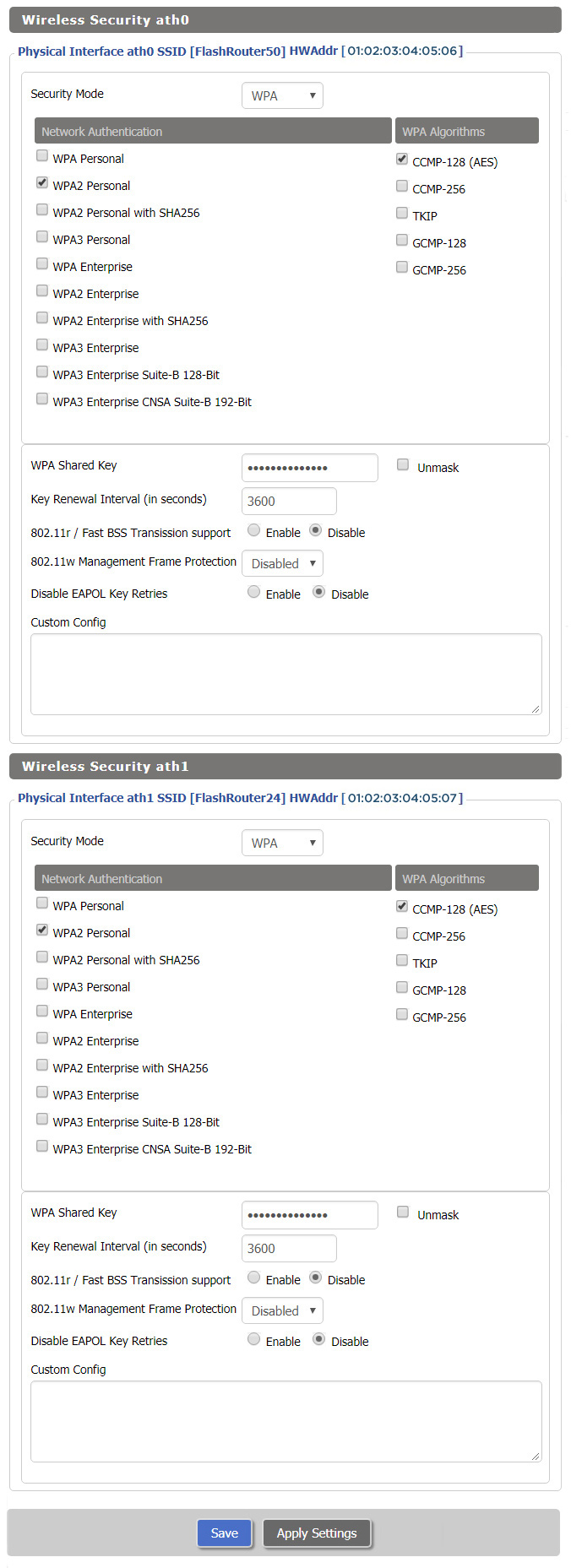
R7800 DD-WRT Wireless Security
The preset R7800 FlashRouter WiFi password is Wireless#[First 5 characters of your router MAC]. The router MAC can be found on the bottom of your router. For e.g. if your MAC is 1459C07E70A8 then your WiFi password is Wireless#1459C
Navigate to the Wireless > Wireless Security to view or edit WiFi passwords.
Netgear R7000 Nighthawk DD-WRT WiFi Settings
Recommended DD-WRT WiFi settings for the Netgear R7000 are based on extensive testing by FlashRouters. Please note that optimal settings may vary depending on external factors such as home size, interference, and the types of WiFi devices you are connecting in your network.
Screenshots below provide a visual display of recommended WiFi and encryption settings exactly as they appear in the Netgear R7000 with DD-WRT firmware.
Navigate to the Wireless > Basic Settings to view or edit WiFi network settings.
2.4 GHz - Wireless-N
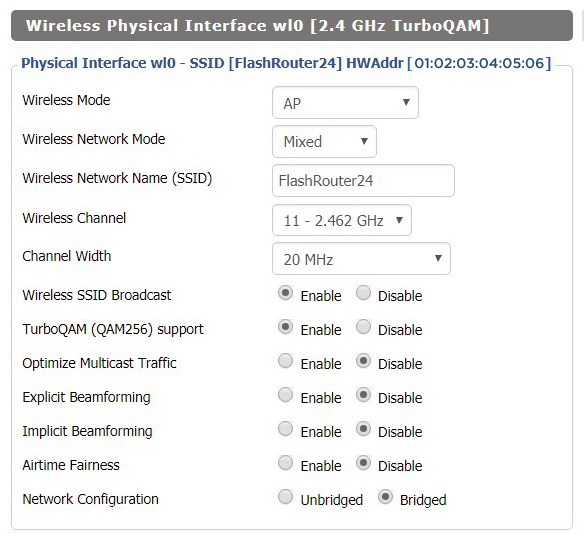
5.0 GHz - Wireless-AC

Additional DD-WRT WiFi Information
Intimidated by all the available WiFi settings? The DD-WRT website provides extensive information about all of the available configuration options in the firmware. Learn about everything from Wireless channels to channel widths and more in the Basic Wireless Settings – DD-WRT Wiki.
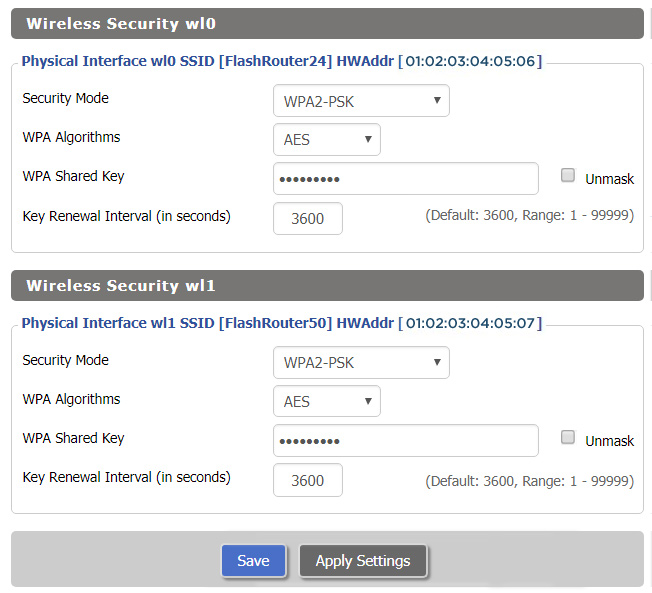
R7000 DD-WRT Wireless Security
The preset R7000 FlashRouter WiFi password is Wireless#[First 5 characters of your router MAC]. The router MAC can be found on the bottom of your router. For e.g. if your MAC is 1459C07E70A8 then your WiFi password is Wireless#1459C
Navigate to the Wireless > Wireless Security to view or edit WiFi passwords.
Netgear R8500 Nighthawk X8 DD-WRT WiFi Settings
Recommended DD-WRT WiFi settings for the Netgear R8500 are based on extensive testing by FlashRouters. Please note that optimal settings may vary depending on external factors such as home size, interference, and the types of WiFi devices you are connecting in your network.
Screenshots below provide a visual display of recommended WiFi and encryption settings exactly as they appear in the Netgear R8500 with DD-WRT firmware.
Navigate to the Wireless > Basic Settings to view or edit WiFi network settings.
5.0 GHz - Wireless-AC #1
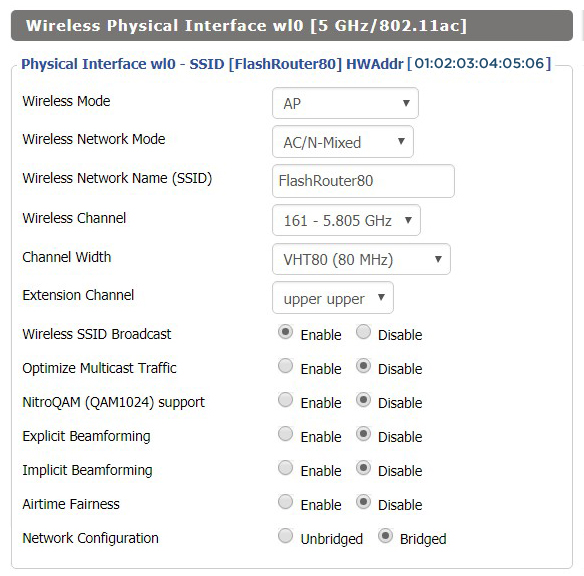
2.4 GHz - Wireless-N
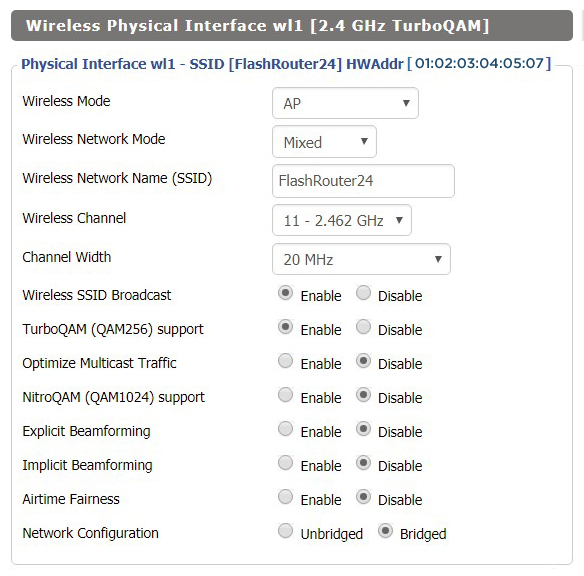
5.0 GHz - Wireless-AC #2
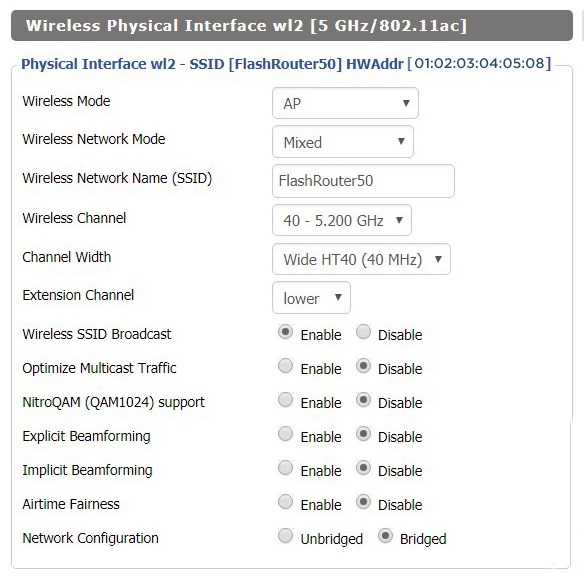
Additional DD-WRT WiFi Information
Intimidated by all the available WiFi settings? The DD-WRT website provides extensive information about all of the available configuration options in the firmware. Learn about everything from Wireless channels to channel widths and more in the Basic Wireless Settings – DD-WRT Wiki.
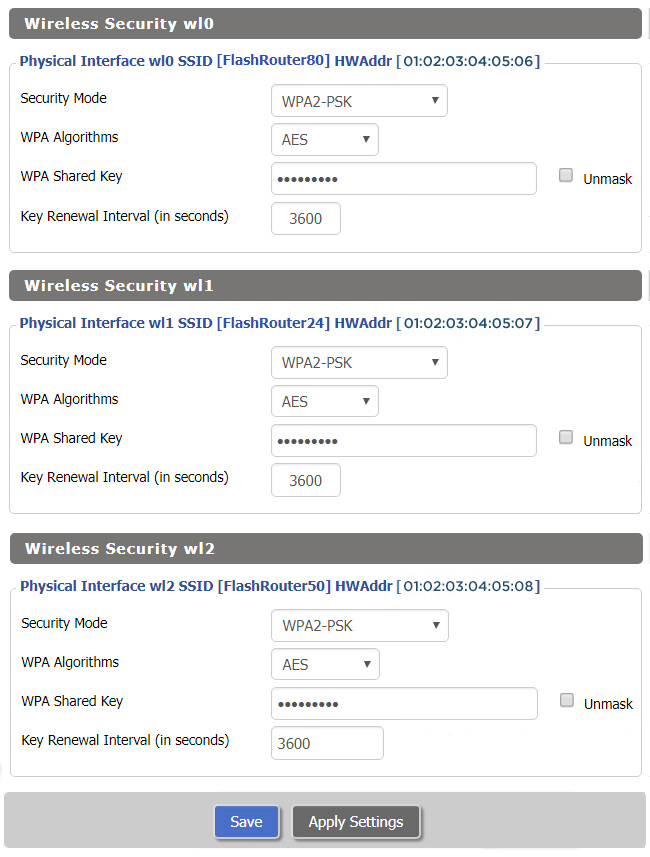
R8500 DD-WRT Wireless Security
The preset Netgear R8500 FlashRouter WiFi password is Wireless#[First 5 characters of your router MAC]. The router MAC can be found on the bottom of your router. For e.g. if your MAC is 1459C07E70A8 then your WiFi password is Wireless#1459C
Navigate to the Wireless > Wireless Security to view or edit WiFi passwords.
Asus RT-AC66U DD-WRT WiFi Settings
Recommended DD-WRT WiFi settings for the Asus RT-AC66U are based on extensive testing by FlashRouters. Please note that optimal settings may vary depending on external factors such as home size, interference, and the types of WiFi devices you are connecting in your network.
Screenshots below provide a visual display of recommended WiFi and encryption settings exactly as they appear in the Asus RT-AC66U with DD-WRT firmware.
Navigate to the Wireless > Basic Settings to view or edit WiFi network settings.
2.4 GHz - Wireless-N

5.0 GHz - Wireless-AC

Additional DD-WRT WiFi Information
Intimidated by all the available WiFi settings? The DD-WRT website provides extensive information about all of the available configuration options in the firmware. Learn about everything from Wireless channels to channel widths and more in the Basic Wireless Settings – DD-WRT Wiki.
RT-AC66U DD-WRT Wireless Security
The preset RT-AC66U FlashRouter WiFi password is Wireless#[First 5 characters of your router MAC]. The router MAC can be found on the bottom of your router. For e.g. if your MAC is 1459C07E70A8 then your WiFi password is Wireless#1459C
Navigate to the Wireless > Wireless Security to view or edit WiFi passwords.
Asus RT-AC56U DD-WRT WiFi Settings
Recommended DD-WRT WiFi settings for the Asus RT-AC56U are based on extensive testing by FlashRouters. Please note that optimal settings may vary depending on external factors such as home size, interference, and the types of WiFi devices you are connecting in your network.
Screenshots below provide a visual display of recommended WiFi and encryption settings exactly as they appear in the Asus RT-AC56U with DD-WRT firmware.
Navigate to the Wireless > Basic Settings to view or edit WiFi network settings.
2.4 GHz - Wireless-N

5.0 GHz - Wireless-AC

Additional DD-WRT WiFi Information
Intimidated by all the available WiFi settings? The DD-WRT website provides extensive information about all of the available configuration options in the firmware. Learn about everything from Wireless channels to channel widths and more in the Basic Wireless Settings – DD-WRT Wiki.
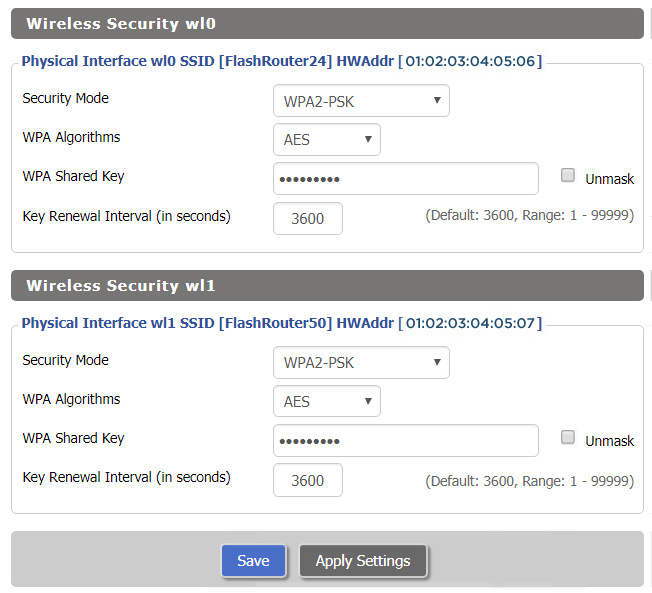
RT-AC56U DD-WRT Wireless Security
The preset RT-AC56U FlashRouter WiFi password is Wireless#[First 5 characters of your router MAC]. The router MAC can be found on the bottom of your router. For e.g. if your MAC is 1459C07E70A8 then your WiFi password is Wireless#1459C
Navigate to the Wireless > Wireless Security to view or edit WiFi passwords.
Linksys WRT1200AC DD-WRT WiFi Settings
Recommended DD-WRT WiFi settings for the Linksys WRT1200AC are based on extensive testing by FlashRouters. Please note that optimal settings may vary depending on external factors such as home size, interference, and the types of WiFi devices you are connecting in your network.
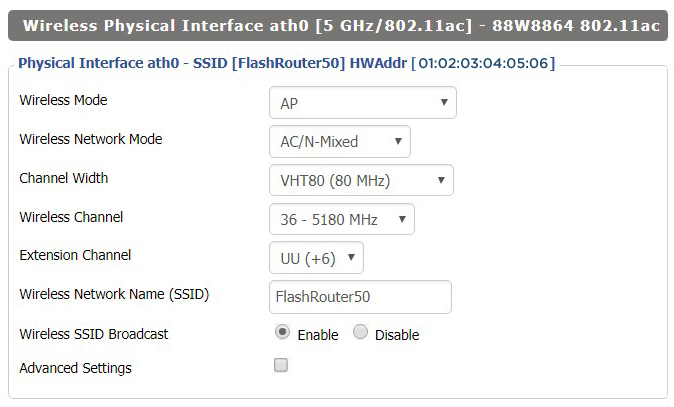
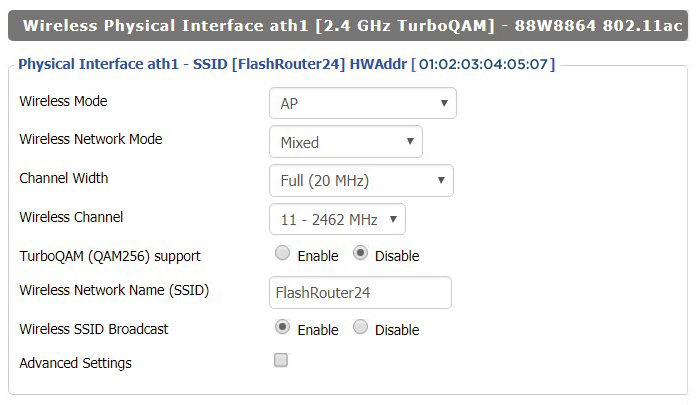
Screenshots below provide a visual display of recommended WiFi and encryption settings exactly as they appear in the Linksys WRT1200AC with DD-WRT firmware.
Navigate to the Wireless > Basic Settings to view or edit WiFi network settings.
5.0 GHz - Wireless-AC
2.4 GHz - Wireless-N
Additional DD-WRT WiFi Information
Intimidated by all the available WiFi settings? The DD-WRT website provides extensive information about all of the available configuration options in the firmware. Learn about everything from Wireless channels to channel widths and more in the Basic Wireless Settings – DD-WRT Wiki.
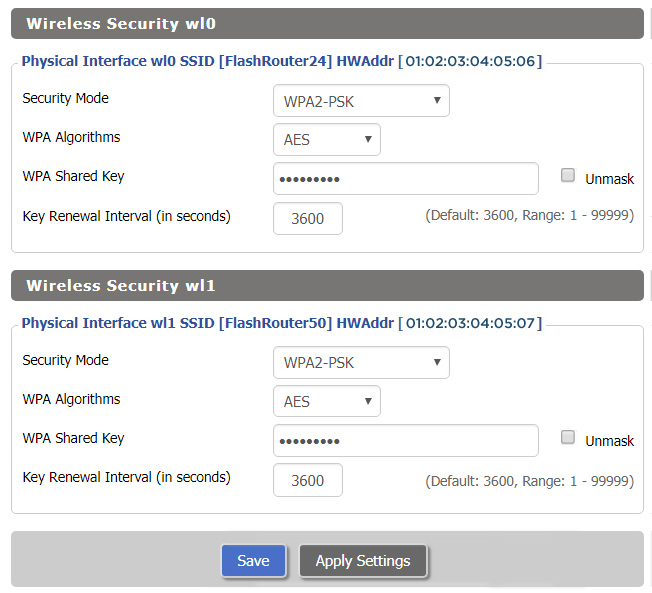
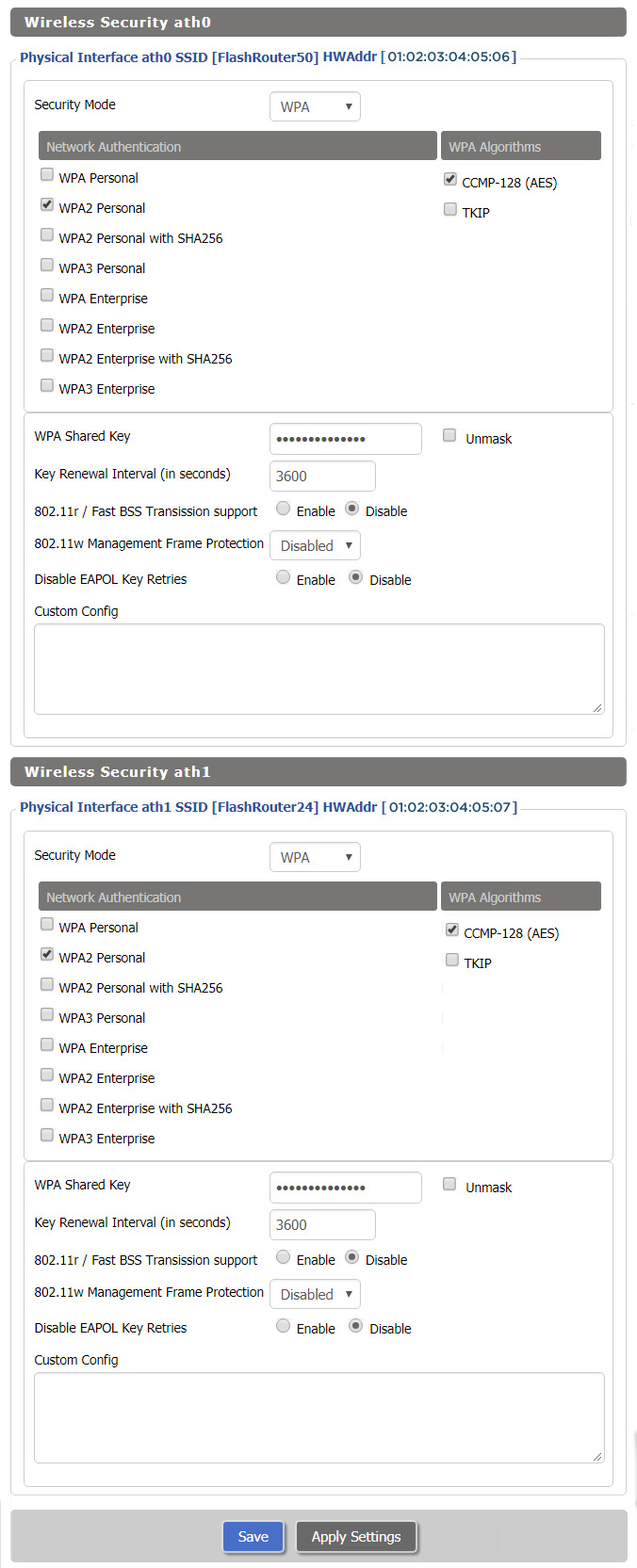
WRT1200AC DD-WRT Wireless Security
The preset WRT1200AC FlashRouter WiFi password is Wireless#[First 5 characters of your router MAC]. The router MAC can be found on the bottom of your router. For e.g. if your MAC is 1459C07E70A8 then your WiFi password is Wireless#1459C
Navigate to the Wireless > Wireless Security to view or edit WiFi passwords.
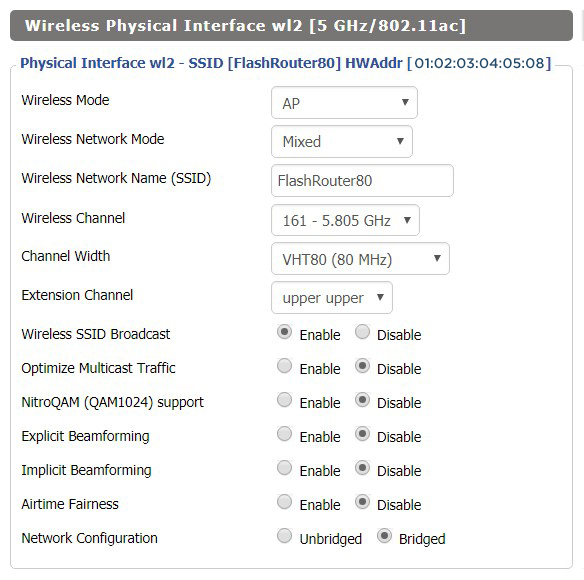
Asus RT-AC5300 DD-WRT WiFi Settings
Recommended DD-WRT WiFi settings for the Asus RT-AC5300 are based on extensive testing by FlashRouters. Please note that optimal settings may vary depending on external factors such as home size, interference, and the types of WiFi devices you are connecting in your network.
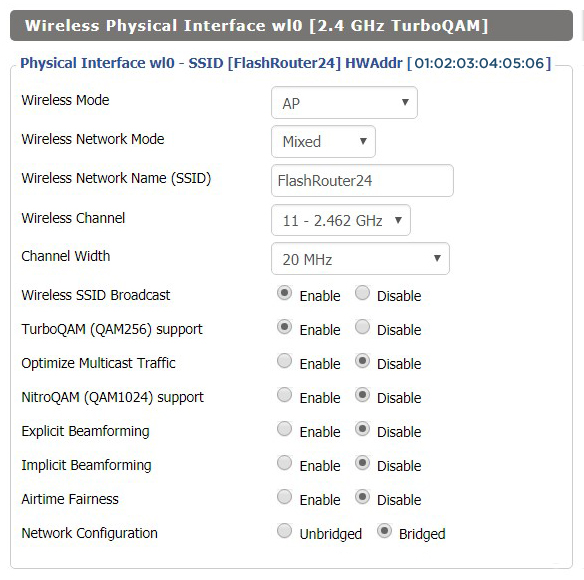
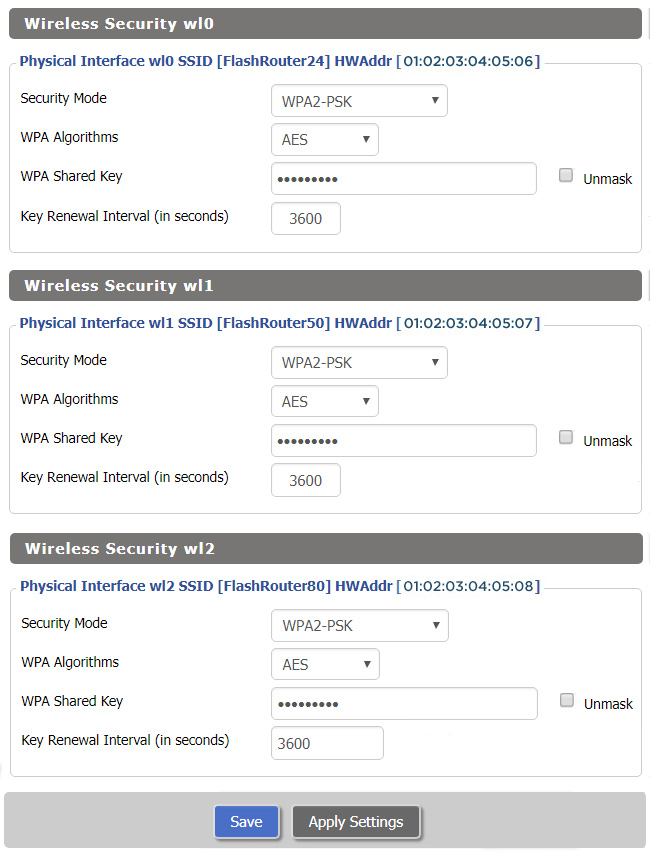
Screenshots below provide a visual display of recommended WiFi and encryption settings exactly as they appear in the Asus RT-AC5300 with DD-WRT firmware.
Navigate to the Wireless > Basic Settings to view or edit WiFi network settings.
2.4 GHz - Wireless-N
5.0 GHz - Wireless-AC #1
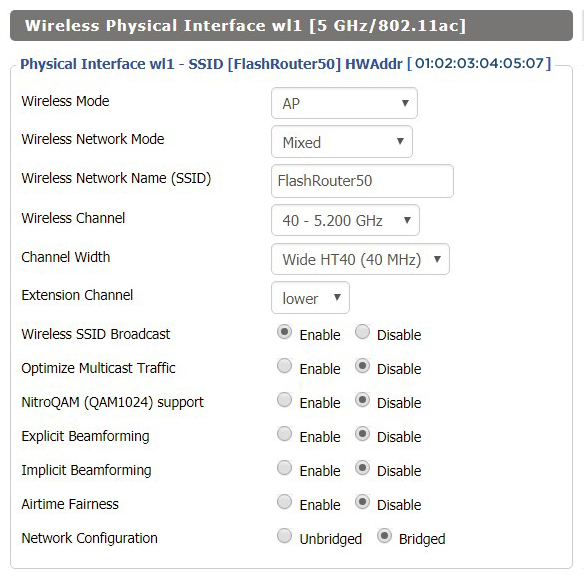
5.0 GHz - Wireless-AC #2
Additional DD-WRT WiFi Information
Intimidated by all the available WiFi settings? The DD-WRT website provides extensive information about all of the available configuration options in the firmware. Learn about everything from Wireless channels to channel widths and more in the Basic Wireless Settings – DD-WRT Wiki.
RT-AC5300 DD-WRT Wireless Security
The preset Asus RT-AC5300 FlashRouter WiFi password is Wireless#[First 5 characters of your router MAC]. The router MAC can be found on the bottom of your router. For e.g. if your MAC is 1459C07E70A8 then your WiFi password is Wireless#1459C
Navigate to the Wireless > Wireless Security to view or edit WiFi passwords.
Netgear R6700V3 Nighthawk DD-WRT WiFi Settings
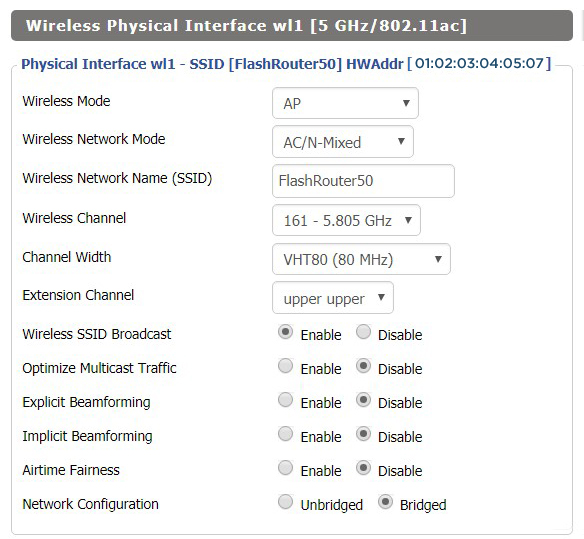
Recommended DD-WRT WiFi settings for the Netgear R6700V3 are based on extensive testing by FlashRouters. Please note that optimal settings may vary depending on external factors such as home size, interference, and the types of WiFi devices you are connecting in your network.
Screenshots below provide a visual display of recommended WiFi and encryption settings exactly as they appear in the Netgear R6700V3 with DD-WRT firmware.
Navigate to the Wireless > Basic Settings to view or edit WiFi network settings.
2.4 GHz - Wireless-N

5.0 GHz - Wireless-AC
Additional DD-WRT WiFi Information
Intimidated by all the available WiFi settings? The DD-WRT website provides extensive information about all of the available configuration options in the firmware. Learn about everything from Wireless channels to channel widths and more in the Basic Wireless Settings – DD-WRT Wiki.
R6700V3 DD-WRT Wireless Security
The preset R6700V3 FlashRouter WiFi password is Wireless#[First 5 characters of your router MAC]. The router MAC can be found on the bottom of your router. For e.g. if your MAC is 1459C07E70A8 then your WiFi password is Wireless#1459C
Navigate to the Wireless > Wireless Security to view or edit WiFi passwords.

Linksys WRT32X DD-WRT WiFi Settings
Recommended DD-WRT WiFi settings for the Linksys WRT32X are based on extensive testing by FlashRouters. Please note that optimal settings may vary depending on external factors such as home size, interference, and the types of WiFi devices you are connecting in your network.
Screenshots below provide a visual display of recommended WiFi and encryption settings exactly as they appear in the Linksys WRT32X with DD-WRT firmware.
Navigate to the Wireless > Basic Settings to view or edit WiFi network settings.
5.0 GHz - Wireless-AC
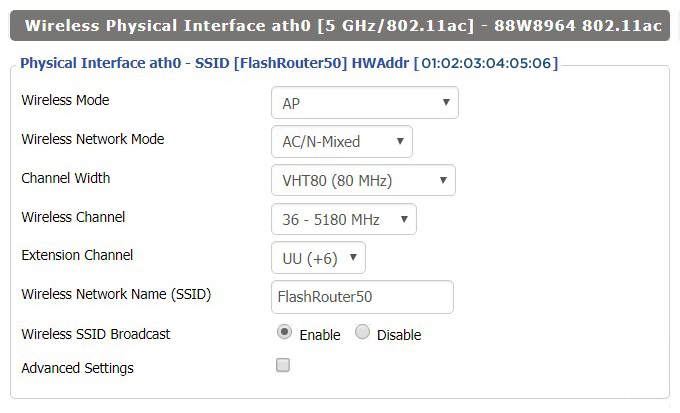
2.4 GHz - Wireless-N
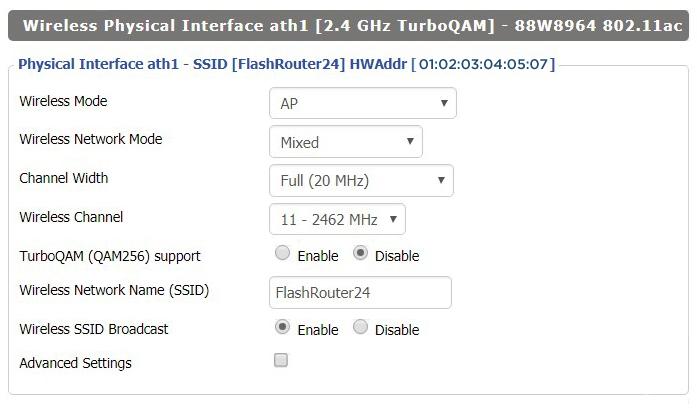
Additional DD-WRT WiFi Information
Intimidated by all the available WiFi settings? The DD-WRT website provides extensive information about all of the available configuration options in the firmware. Learn about everything from Wireless channels to channel widths and more in the Basic Wireless Settings – DD-WRT Wiki.
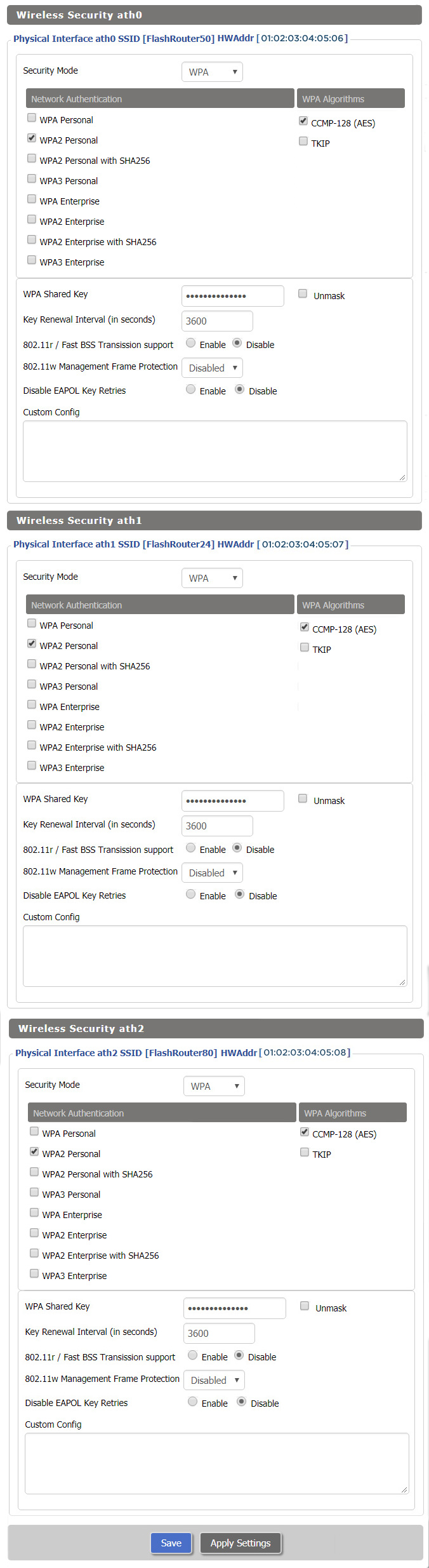
WRT32X DD-WRT Wireless Security
The preset WRT32X FlashRouter WiFi password is Wireless#[First 5 characters of your router MAC]. The router MAC can be found on the bottom of your router. For e.g. if your MAC is 1459C07E70A8 then your WiFi password is Wireless#1459C
Navigate to the Wireless > Wireless Security to view or edit WiFi passwords.

Linksys WRT3200ACM DD-WRT WiFi Settings
Recommended DD-WRT WiFi settings for the Linksys WRT3200ACM are based on extensive testing by FlashRouters. Please note that optimal settings may vary depending on external factors such as home size, interference, and the types of WiFi devices you are connecting in your network.
Screenshots below provide a visual display of recommended WiFi and encryption settings exactly as they appear in the Linksys WRT3200ACM with DD-WRT firmware.
Navigate to the Wireless > Basic Settings to view or edit WiFi network settings.
5.0 GHz - Wireless-AC

2.4 GHz - Wireless-N

Additional DD-WRT WiFi Information
Intimidated by all the available WiFi settings? The DD-WRT website provides extensive information about all of the available configuration options in the firmware. Learn about everything from Wireless channels to channel widths and more in the Basic Wireless Settings – DD-WRT Wiki.
WRT3200ACM DD-WRT Wireless Security
The preset WRT3200ACM FlashRouter WiFi password is Wireless#[First 5 characters of your router MAC]. The router MAC can be found on the bottom of your router. For e.g. if your MAC is 1459C07E70A8 then your WiFi password is Wireless#1459C
Navigate to the Wireless > Wireless Security to view or edit WiFi passwords.
Connect FlashRouter to Internet
All FlashRouters are compatible with all ISP service types such as fiber, cable, DSL, and satellite. As long as you have a modem, modem/router, or router capable of an ethernet connection your FlashRouter will have no problems connecting to the internet.
Internet Service Providers (ISP) include a modem or modem/router combo to connect your network devices to the internet. In some instances your ISP will provide a separate router as well as the modem. You can replace this router with a FlashRouter or use both in a dual router setup.
Single router setup
If you would like to replace your outdated router or avoid paying to rent a router from your ISP then you should use a FlashRouter as the only WiFi device in your network.
In a single router setup the FlashRouter will be wired directly to your modem via ethernet cable and will be the only router in the setup.
Connect to your ISP modem
Wire an ethernet cable from an open ethernet port on your modem to the WAN/internet port of the FlashRouter.
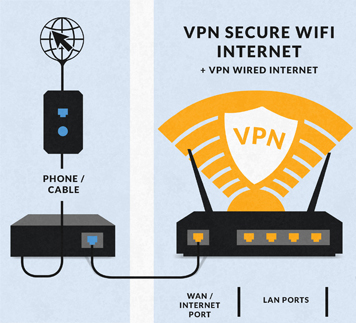
On Asus FlashRouters the WAN/internet port will be blue.

On Linksys FlashRouters the WAN/internet port will be yellow.

On Netgear FlashRouters the WAN/internet port will be yellow.

Power cycle modem and router
Once you have properly connected an ethernet cable from your modem into the FlashRouter internet port you must power cycle your network devices to establish an internet connection.
- Power off your ISP modem and the FlashRouter.
- Power on the ISP modem and wait for it to fully boot up.
- Power on the FlashRouter.
Dual router setup
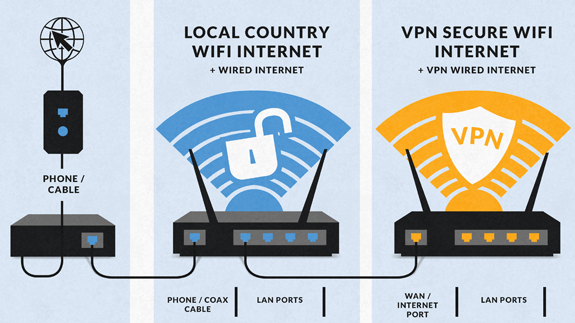
If you would like to keep your existing WiFi network in place, and simply want to add in a VPN WiFi network with a FlashRouter then you can do so using a dual router setup. No settings in your existing network router need to change to add a FlashRouter in a dual router setup. Since we preset all FlashRouters to a unique Local IP Address, there won’t be a conflict with your existing router.
In a dual router setup the FlashRouter is wired to your existing router via ethernet cable and you will have two completely segmented WiFi networks available.
Connect to your existing router
Remember if your existing router is connecting to the internet without issue already, make sure to keep the ethernet cable between your modem and existing router internet port in place.
Now connect another ethernet cable from a LAN/numbered port on your existing router to the WAN/internet port of the FlashRouter.
Reference the images above to see your WAN/internet port color.
Power cycle all network devices
Once you have properly connected an ethernet cable from your existing router into the FlashRouter internet port you must power cycle your network devices to establish an internet connection.
- Power off your ISP modem, existing router, and the FlashRouter.
- Power on the ISP modem and wait for it to fully boot up.
- Power on the existing router and wait for it to fully boot up.
- Power on the FlashRouter.
Verify a successful internet connection
Once the power cycling steps are complete and the FlashRouter is powered up, start connecting your internet capable devices via ethernet or WiFi. Visit any website and make sure the page fully loads.
If you want to check your internet IP address that is visible to websites and services that you visit over the internet check out WhatIsMyIPAddress.com.
My 2.4GHz network is not showing up
If you ever have an issue with WiFi, you can always wire directly into the FlashRouter to verify and/or update your current WiFi settings.
Enter the recommended wireless settings
Our team has tested the wireless functionality for each FlashRouter that we offer and shared our recommended wireless settings in our Wifi Setup area. Replicate the settings for your FlashRouter model found on that page if the 2.4GHz is not showing.
Change the wireless channel
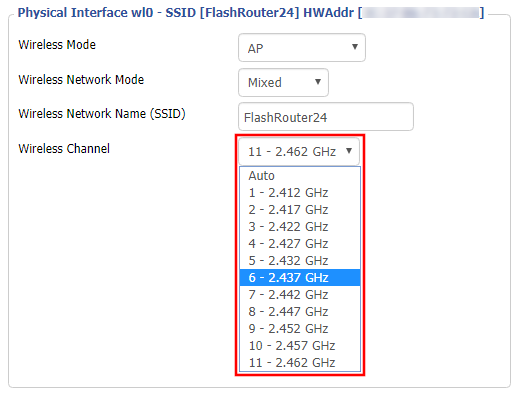
Navigate to Wireless > Basic Settings
Change the wireless channel setting for the 2.4GHz band that is not appearing. The most broadly compatible channels are 6 and 11.
CLICK APPLY SETTINGS
Refresh your device's network adapter
In rare instances the wireless adapter for your device may stop picking up WiFi networks and must be reset. This will be different for each device, that is why the best way to refresh your wireless adapter is to simply reboot any device in question and see if the adapter now picks up your WiFi networks.
Review wireless Status
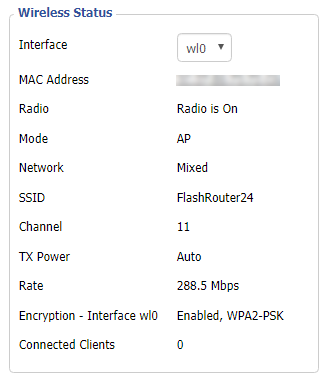
Navigate to Status > Wireless
The readouts on this page can help tell if there are errors with the FlashRouter’s wireless. View our article on how to read the Wireless Status page for more information.
Change WiFi name and password on Asus
Set a custom WiFi network name and password for your devices to join the Asus FlashRouter’s network.
View our guide for more instructions on how to access AsusWRT firmware settings.
1. Under General select Network Map.
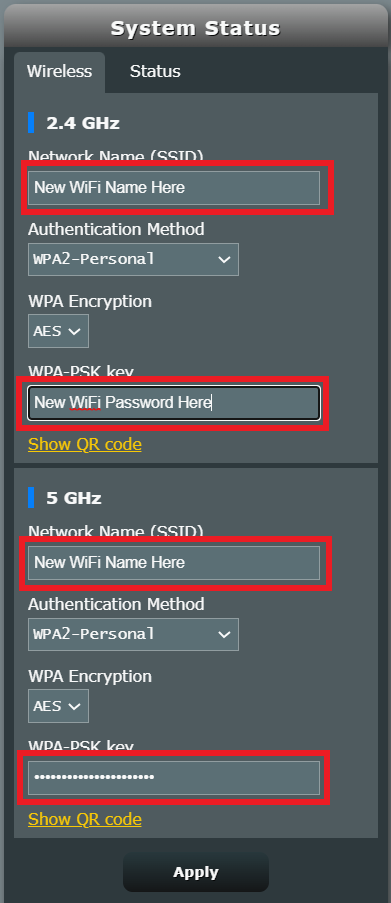
2. In the Network name (SSID) field enter the name you want your Asus WiFi to appear as. This can be the same or different for both 2.4GHz and 5GHz bands. We typically advise setting different names for each so you can connect your streaming devices to the 5GHz band as that is the faster WiFi band.
3. In the WPA-PSK key field enter the password you want to join your devices to the Asus WiFi network. If your WiFi names are the same for 2.4GHz and 5GHz make sure they have the exact same wireless password set.
4. Click Apply and then rejoin the new wireless network.
Change WiFi name and password on Merlin
Set a custom WiFi network name and password for your devices to join the Merlin FlashRouter’s network.
Login to Asus Merlin firmware settings in a browser on any computer or smart device.
1. Under General select Network Map.
2. In the Network name (SSID) field enter the name you want your Asus WiFi to appear as. This can be the same or different for both 2.4GHz and 5GHz bands. We typically advise setting different names for each so you can connect your streaming devices to the 5GHz band as that is the faster WiFi band.
3. In the WPA-PSK key field enter the password you want to join your devices to the Merlin WiFi network. If your WiFi names are the same for 2.4GHz and 5GHz make sure they have the exact same wireless password set.
4. Click Apply and then rejoin the new wireless network.
Change WiFi name and password on Roqos
Change your Roqos’ WiFi Network Name and Password to anything you like. Make sure it is not a duplicate of an existing WiFi name.
Login to Roqos Core UI web app in a browser on any computer or smart device.
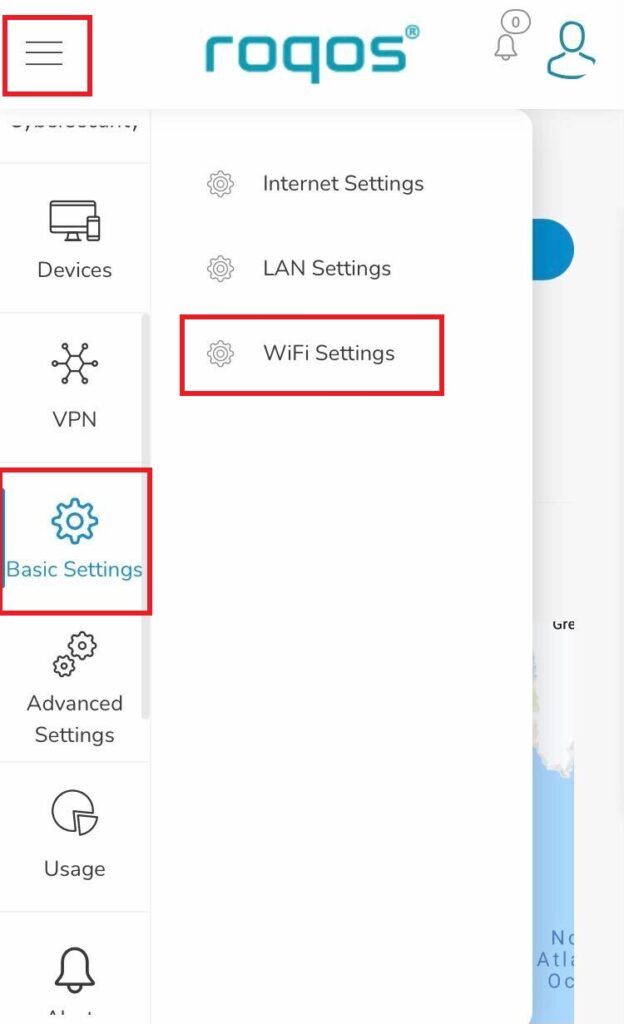
1. Click the navigation menu and select Basic Settings > WiFi Settings.
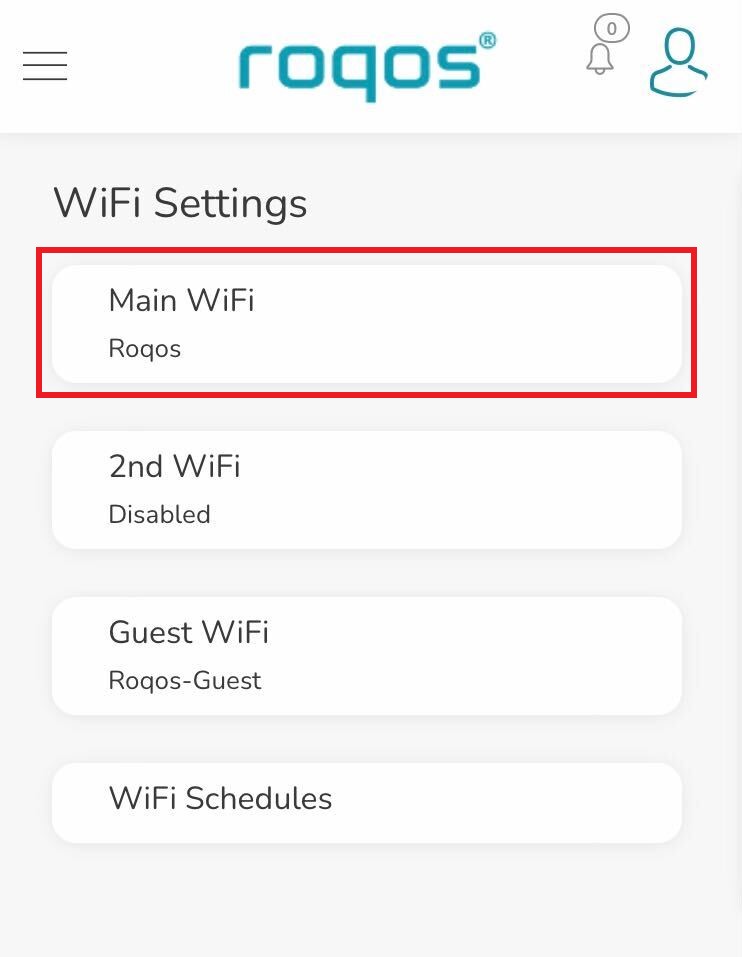
2. Click Main WiFi.
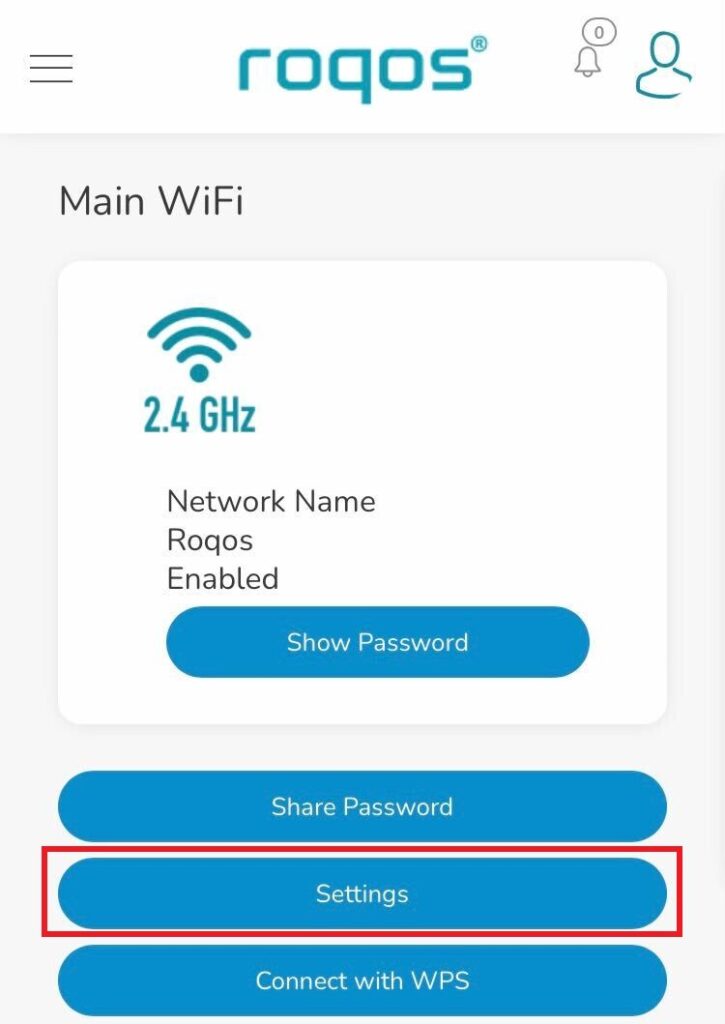
3. Click Settings.
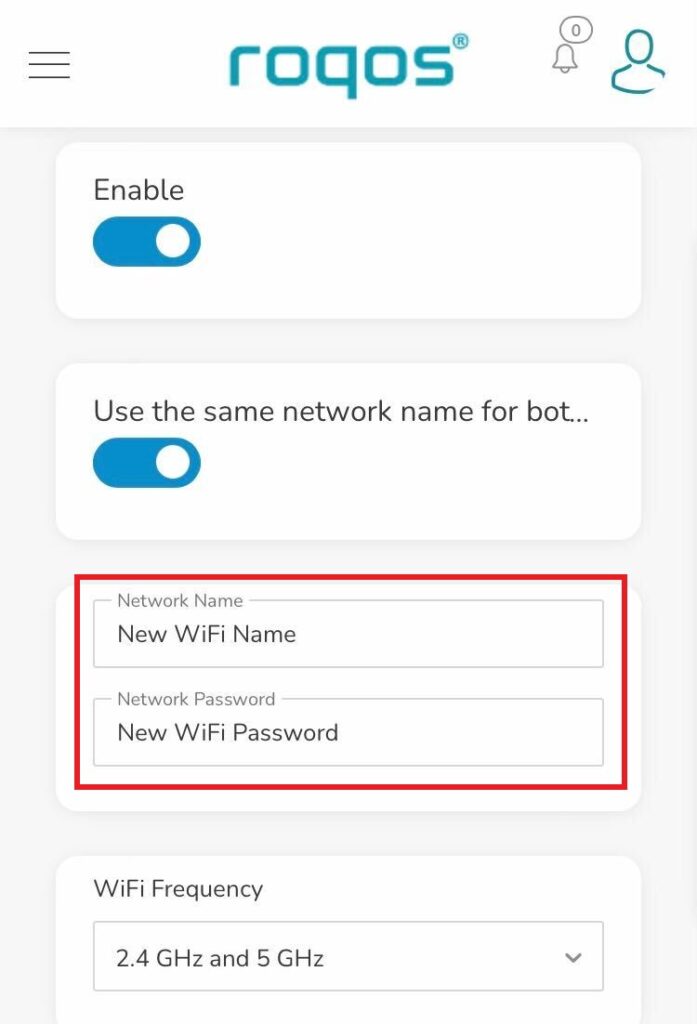
4. Enter the new Network Name and Network Password. Click Save.
5. Reconnect your WiFi devices to the new network with the password you just set.
Wireless Repeater – WiFi as WAN on Roqos
WiFi as WAN is a feature of the Roqos software which allows you to use an existing WiFi network as the Internet source for the Roqos router instead of an ethernet cable connection. This is a great solution for travelling users who do not have access to the modem/router in their hotel or AirBnB.
Login to Roqos Core UI web app in a browser on any computer or smart device.
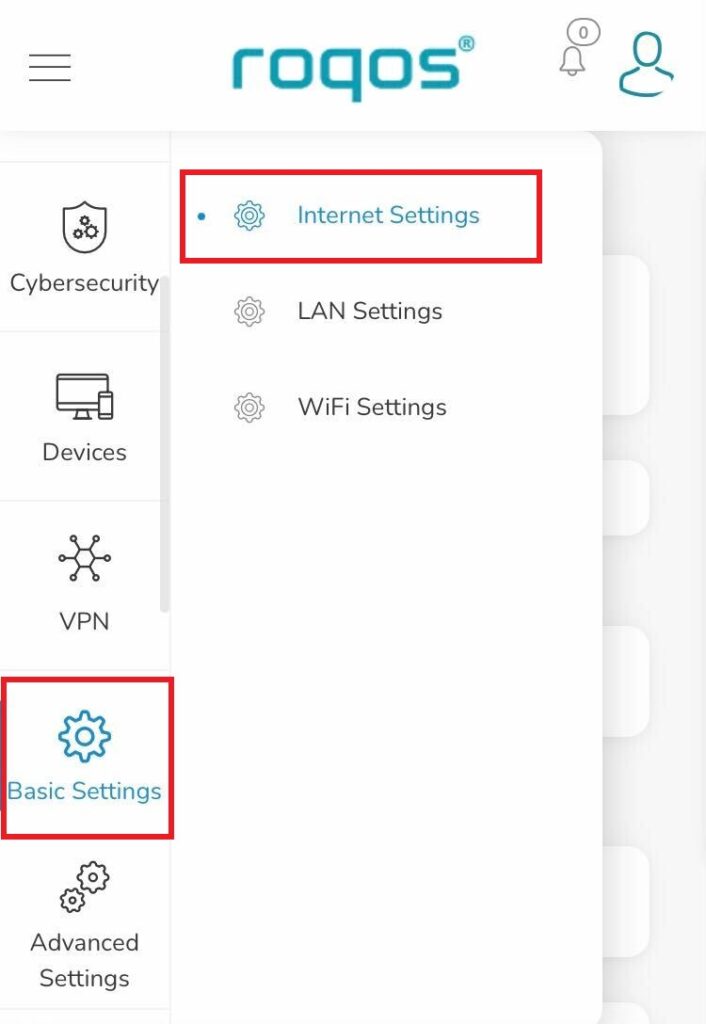
1. Click the navigation menu and select Basic Settings > Internet Settings.
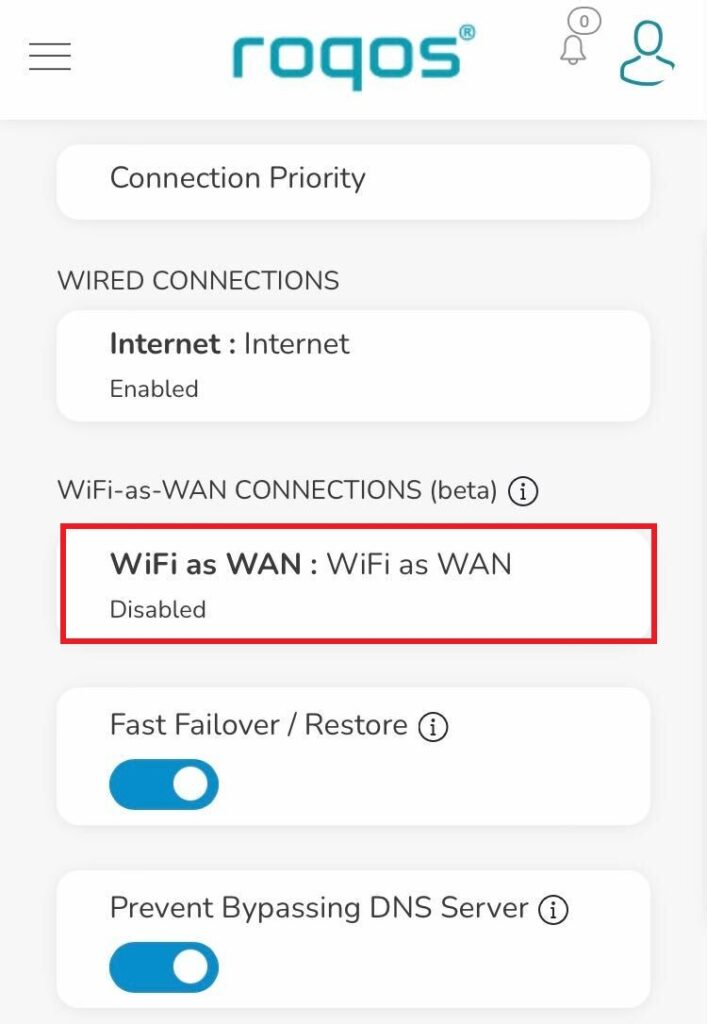
2. Click WiFi as WAN.
3. Scroll down and select the existing WiFi network you wish to use for WAN/Internet from the Nearby Wireless Networks list.
4. Enter the correct password for the existing WiFi network and click Connect.
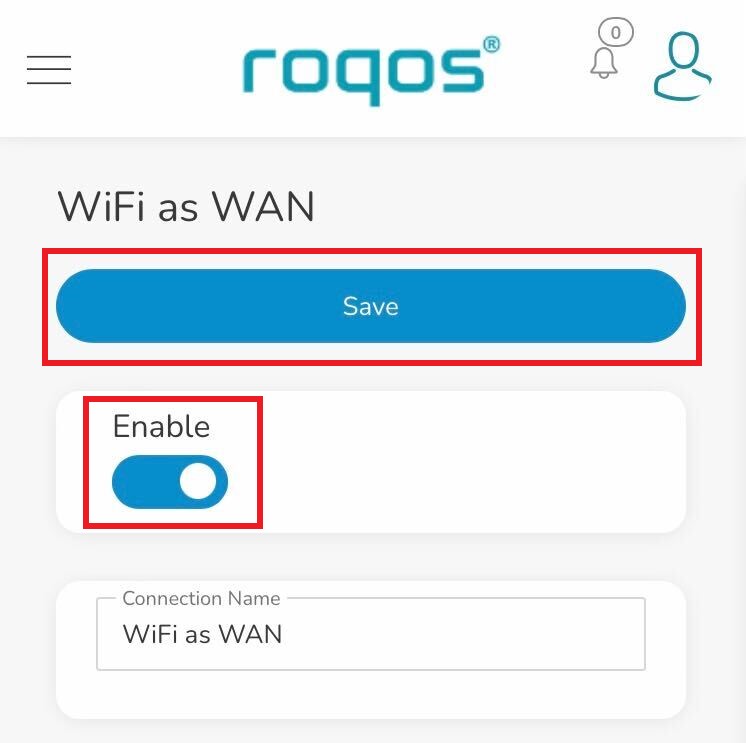
5. Toggle the Enable slide and click Save.
Be patient as the connection is made. It usually takes 30 seconds to a minute to connect. Then test that your Internet is working while connected to the Roqos network.
Which DD-WRT wireless extender setup should I be using?
FlashRouters supports four unique DD-WRT wireless extender setups – options similar to an open source Mesh network. Each different wireless extender configuration serves a different purpose. Read below to see which guide fits your configuration requirements!
Wireless Repeater
Why should I choose Wireless Repeater Setup?
- If you have a MiFi wireless only internet connection or other type of WiFi internet where there is no access to any ethernet port for a wired internet connection, then you can setup a wireless repeater network to both extend WiFi and add wired connection capabilities.
- If you have a large home or office area that requires additional WiFi coverage can use a wireless repeater setup to extend the existing network.
- If you want to create a separate VPN WiFi network in your home without placing the FlashRouter in the same room as your primary router you can use wireless repeater to establish a WiFi internet connection and then connect to VPN on your WiFi repeater network.
- If you want a wireless Dual Router setup option where you can have local ISP IP address through your main router WiFi network and your VPN IP address through your FlashRouter Wireless Repeater WiFi network, both available for you to connect at all times. Each network is on a unique subnet.
View the FlashRouter Wireless Repeater Setup Guide.
Wireless Repeater Bridge
Use Cases
Wireless Repeater Bridge Setup
- Anyone that needs all their devices connected to the same local network.
- Anyone with a MiFi internet connection that does not have an ethernet port and has no need for VPN.
- Anyone with a large wireless area that requires additional coverage.
Wireless Client Bridge
Use Cases
- Anyone with a MiFi internet connection that needs wired access.
- Anyone that needs additional wired ports instead of using a switch.
- Anyone with wired only devices in their home that are too far from your main router.
Wireless Access Point DHCP Forwarder
Use Cases
Wireless Access Point DHCP Forwarder Setup
- Anyone that needs their devices connected to the same local network and wants lossless LAN to LAN speeds via wireless and ethernet connection.
- Anyone that wants to use their main router to provide DHCP to their router instead of having an additional DHCP server.
Setting up a Guest WiFi Network on Roqos
Create a Guest WiFi network on your Roqos to segment certain devices from the main network and set custom content filters as you see fit. Note that this is only for 2.4GHz wireless.
Login to Roqos Core UI web app in a browser on any computer or smart device.
1. Click the navigation menu and select Basic Settings > WiFi Settings.
2. Click Guest WiFi.
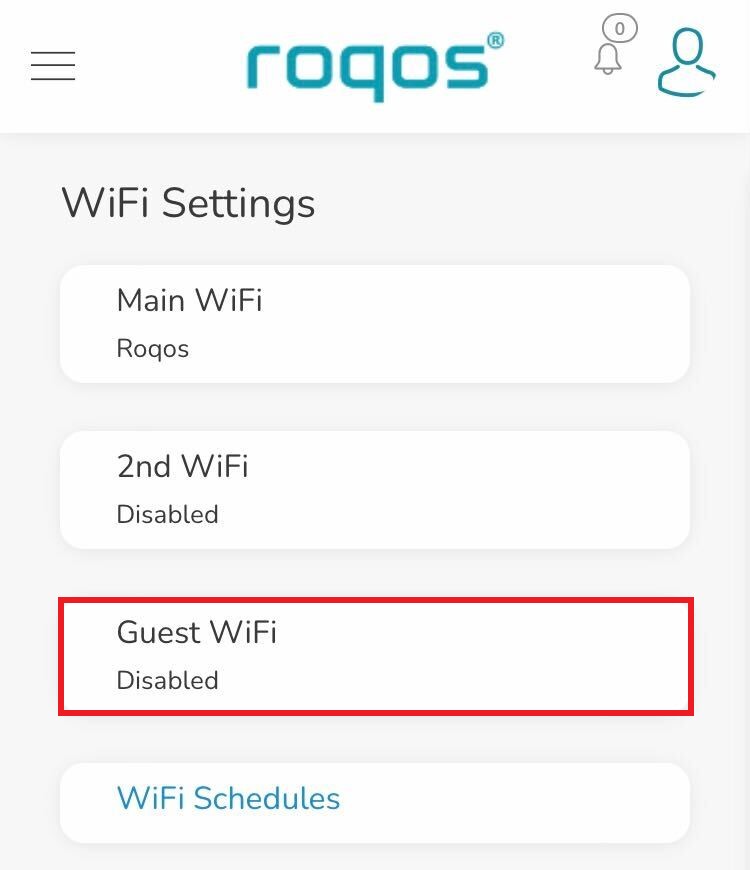
3. Toggle the Enable slider and set the Network Name and Guest WiFi Password. Click Save.
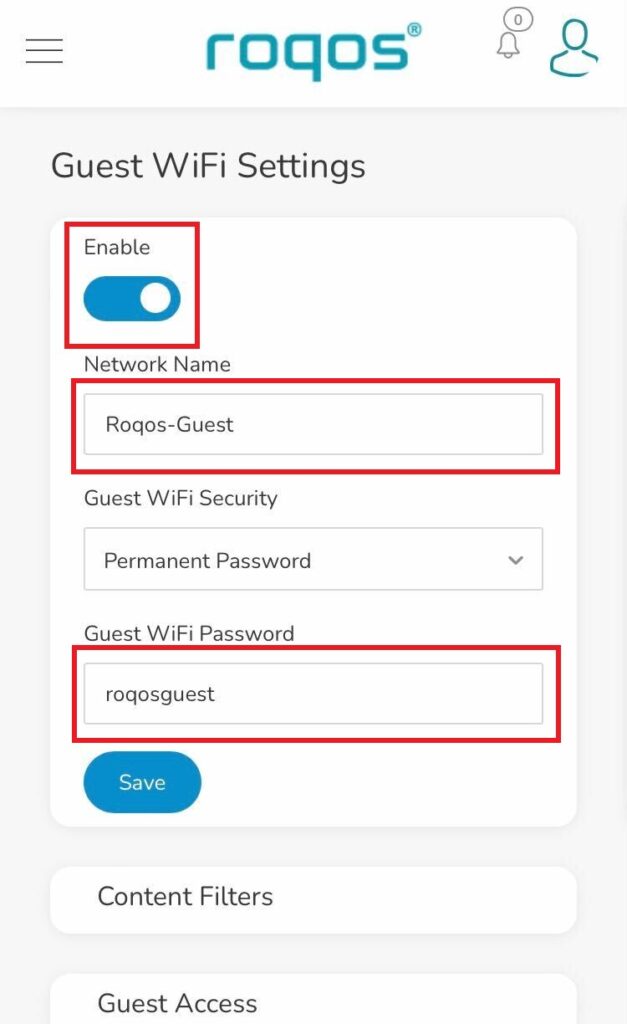
4. Optional: If you wish to set specific Content Filters for the Guest Network and set the Filters that you see fit.
How to Access Your AsusWRT FlashRouter Settings
This quick guide will walk you through connecting to your AsusWRT FlashRouter and logging into the admin settings page. You’ll use either WiFi or an Ethernet cable, then access the router dashboard through your browser.
Step 1. Connect Your Device to the Router
You can connect by WiFi or Ethernet:
- WiFi: Look for a network name like FlashRouter24 or FlashRouter50.
- The WiFi password is set to: Wireless#[First 5 characters of your router’s MAC]
- Example: If your MAC is CC28A07E70A8, your WiFi password is Wireless#CC28A.
- ⚠️ Be sure to capitalize the “W” in Wireless.
- Ethernet: Plug an Ethernet cable from your computer into one of the router’s LAN ports (usually marked or color-coded differently from the WAN port).
👉 Pro tip: Disconnect from any other WiFi networks during setup.
Step 2. Open the Router Login Page
- Open a web browser (Chrome, Safari, Firefox, Edge).
- In the address bar, type: 192.168.50.1 or go to asusrouter.com
- Press Enter.
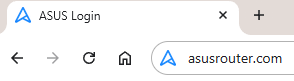
This is the local router dashboard address (not a public website). If the page doesn’t load:
- Try a different browser.
- Clear your cache.
- Ensure your device is connected to the FlashRouter network.
Step 3. Log In to the Router Settings
- Default username:
flashrouter - Default password:
asuswrt-admin1 - Some older devices may use:
asuswrt1orasuswrt - This is the factory default for AsusWRT routers shipped by FlashRouters.
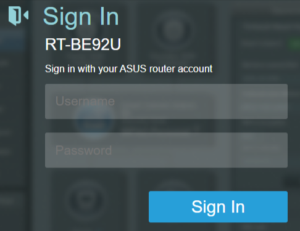
💡 Once you’re in, you can update your admin password in the settings for extra security.
Next Steps
Now that you’ve accessed your AsusWRT FlashRouter, you can:
- Set up your VPN service
- Customize your WiFi name and password
- Adjust device controls and security settings
Check our support library for your specific VPN setup guide.
My WiFi password is not working
Keep in mind that passwords are case sensitive.
The preset DD-WRT FlashRouter WiFi password is Wireless#[First 5 characters of your router MAC]. The router MAC can be found on the bottom of your router. For e.g. if your MAC is 1459C07E70A8 then your WiFi password is Wireless#1459C
Verify wireless password
Connect an ethernet cable from a numbered port on the FlashRouter to a computer and access the FlashRouter’s settings.
Navigate to Wireless > Wireless Security
Check the Unmask box and note the wireless password that is entered.
Verify the wireless settings
Make sure that you have WPA2 Personal / AES set as the security settings for all bands. For some router models make sure the CCMP-128 (AES) box is checked for all bands.
Forget network on your device
Wireless devices usually offer a “forget” network feature to remove a wireless network from the saved information of the wireless adapter. If you have updated your WiFi password and are trying to connect on a device that previously used the old WiFi password then removing the wireless network and then trying to connect fresh can help with this issue.
DD-WRT Wifi Setup
DD-WRT Router WiFi Setup
How to Access Your GL.iNet FlashRouter Settings
This quick guide walk you through connecting to your GL.iNet FlashRouter (Flint, Slate, Beryl, or Marble) and logging into the admin settings page. You’ll use either WiFi or an Ethernet cable, then access the router dashboard through your browser.
Step 1. Connect Your Device to the Router
You can connect by WiFi or Ethernet:
- WiFi: Look for a network name like FlashRouter24 or FlashRouter50
- The WiFi password has been set to: Wireless#9483C
- ⚠️ Be sure to capitalize the “W” in
- Ethernet: Plug an Ethernet cable from your computer into one of the router’s LAN ports (usually marked or color-coded differently from the WAN port).
👉 Pro tip: Disconnect from any other WiFi networks during setup.
Step 2. Open the Router Login Page
- Open a web browser (Chrome, Safari, Firefox, Edge).
- In the address bar, type: 192.168.8.1
- Press Enter.
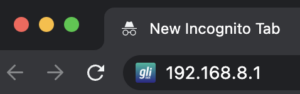
This is the local router dashboard address (not a public website). If the page doesn’t load:
- Try a different browser.
- Clear your cache.
- Ensure your device is connected to the FlashRouter network.
Step 3. Log In to the Router Settings
- Default password:
glopenwrt1oropenwrt - This is the factory default for all GL.iNet routers shipped by FlashRouters.
💡 Once you’re in, you can update your admin password in the settings for extra security.
Next Steps
Now that you’ve accessed your GL.iNet FlashRouter, you can:
- Set up your VPN service
- Customize your WiFi name and password
- Adjust device controls and security settings
Check our support library for your specific VPN setup guide.
Wireless Guest Network Setup – Bridged (Advanced)
If you would like to prevent visitors from connecting to your main WiFi network then you can create a Bridged Guest Network that will prevent access to the main router. This setup also allows you to create different rules for different WiFi SSID’s in your home ranging from QoS controls, access restrictions, VPN network segmentation, and more.
Preparing for Wireless Guest Network Setup
If you have a Dual-band or Tri-Band router you can setup a WiFi Guest Network, creating a separate VLAN (virtual local area network) for your visitors, or in order to segment your VPN networks on any band you like. We recommend using the 2.4GHz network for your DD-WRT Guest Wireless Network so it is compatible with the most possible WiFi devices. Setting up a guest network for visitors in your home allows you to keep them off of your main WiFi network.
We recommend performing this setup while connected to the FlashRouter via ethernet cable. If your computer does not have an ethernet port and you must proceed via wireless connection to the FlashRouter pay attention to the wireless connection as you may need to rejoin the FlashRouter’s network after making changes.
DD-WRT Router Setup for Wireless Guest Network
Enter Wireless settings
Navigate to Wireless > Basic Settings
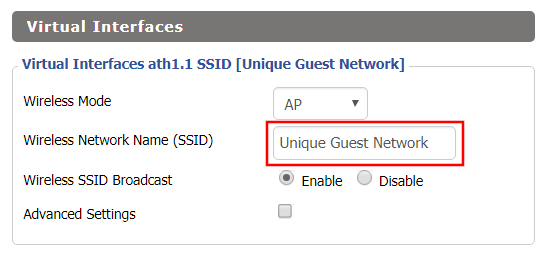
- Under the 2.4GHz or 5GHz Interface click the Add button.
- In the Wireless Network Name (SSID) field enter the unique network name of the guest network.
- Click Save.
Enter Wireless Security settings
Navigate to Wireless > Wireless Security
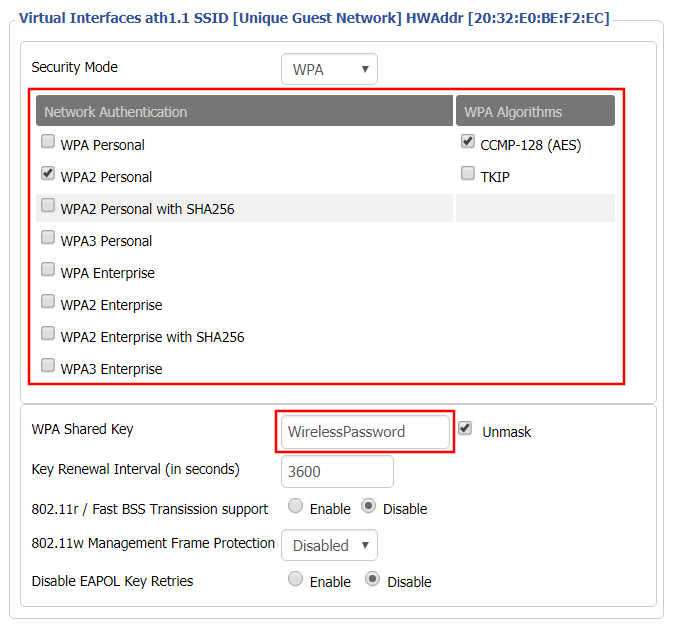
- Duplicate the wireless security settings that are set for the other bands for the newly created virtual interface.
- Click Apply Settings.
- Reboot your router.
Create Bridge
Navigate to Setup > Networking
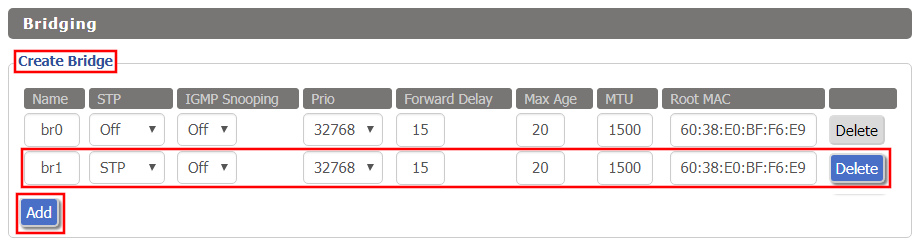
- Under Create Bridge click Add. Name the newly created bridge br1.
- Click Apply Settings
Assign to Bridge

- Under Assign to Bridge select br1 from the Assignment dropdown. Select wl1.1 or ath1.1 depending on your router model.
- Click Apply Settings.
Depending on the router model and WiFi band you are using, the wireless interfaces will be labelled differently.
This setting can be labelled wl1.1, ath0.1, wl2.1, and so on. Make sure when you get up to the bridge assignment section that you are using the correct guest network Virtual Interface.
Network Configuration br1
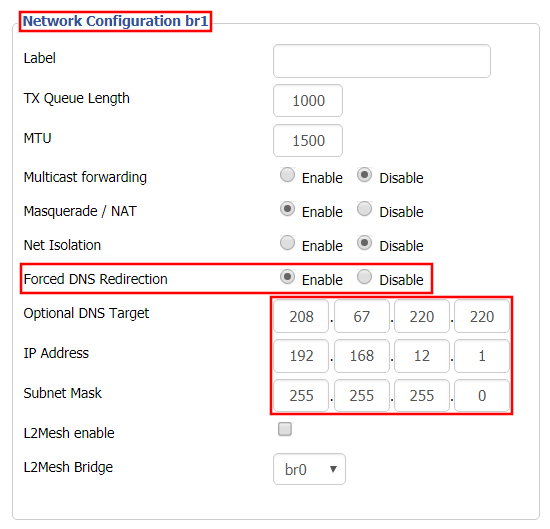
- Under Network Configuration br1 select Enable for Forced DNS Redirection.
- Set Optional DNS Target to 208.67.220.220
- Set IP Address to 192.168.12.1
- Set Subnet Mask to 255.255.255.0
- Click Apply Settings.
Multiple DHCP Server
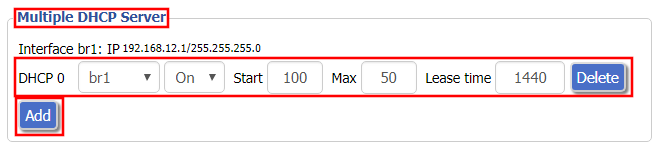
- Under Multiple DHCP Server click Add.
- Set the first dropdown to br1.
- Click Apply Settings.
- Reboot your router.
Firewall Rules
Navigate to Administration > Commands
- Copy the fire script from below and paste into the empty Commands shell
- Click Save Firewall.
- Wait one minute and then reboot your router.
iptables -I FORWARD -i br1 -o br0 -m state –state NEW -j DROP
iptables -I FORWARD -i br0 -o br1 -m state –state NEW -j DROP
iptables -I INPUT -i br1 -p tcp –dport telnet -j REJECT –reject-with tcp-reset
iptables -I INPUT -i br1 -p tcp –dport ssh -j REJECT –reject-with tcp-reset
iptables -I INPUT -i br1 -p tcp –dport www -j REJECT –reject-with tcp-reset
iptables -I INPUT -i br1 -p tcp –dport https -j REJECT –reject-with tcp-reset
You will now have a working Bridged Guest Network on the FlashRouter. By inputting the firewall rules, this will also prevent any guests on your network from gaining access to your router settings.
Back up your settings
Navigate to Administration > Backup
- Click the Backup button.
- A file named nvrambak.bin will be saved to your computer.
- You can load nvrambak.bin to restore your settings in the event of a reset.
Wireless Guest Network Setup – Unbridged (Recommended)
If you would like to prevent visitors from connecting to your main WiFi network then you can create a separate Guest Network that will prevent access to the main router. This setup also allows you to create different rules for different WiFi SSID’s in your home ranging from QoS controls, access restrictions, VPN network segmentation, and more.
Preparing for Wireless Guest Network Setup
If you have a Dual-band or Tri-Band router you can setup a WiFi Guest Network, creating a separate VLAN (virtual local area network) for your visitors, or in order to segment your VPN networks on any band you like. We recommend using the 2.4GHz network for your DD-WRT Guest Wireless Network so it is compatible with the most possible WiFi devices. Setting up a guest network for visitors in your home allows you to keep them off of your main WiFi network.
We recommend performing this setup while connected to the FlashRouter via ethernet cable. If your computer does not have an ethernet port and you must proceed via wireless connection to the FlashRouter. Be sure to pay attention to the wireless connection as you may need to rejoin the FlashRouter’s network after making changes.
DD-WRT Router Setup for Wireless Guest Network
Enter Wireless settings
Navigate to Wireless > Basic Settings
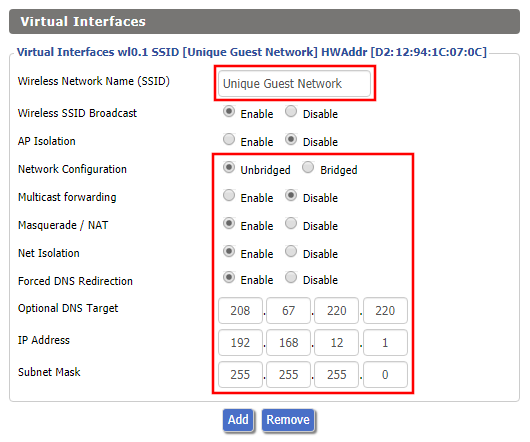
Under the 2.4GHz or 5GHz Interface click the Add button.
Wireless Network Name (SSID)
Enter the a unique network name for the guest network.
Network Configuration
Unbridged
Force DNS Redirection
Enable
Optional DNS Target
208.67.220.220
IP Address
192.168.12.1
Subnet Mask
255.255.255.0
CLICK SAVE
Enter Wireless Security settings
Navigate to Wireless > Wireless Security
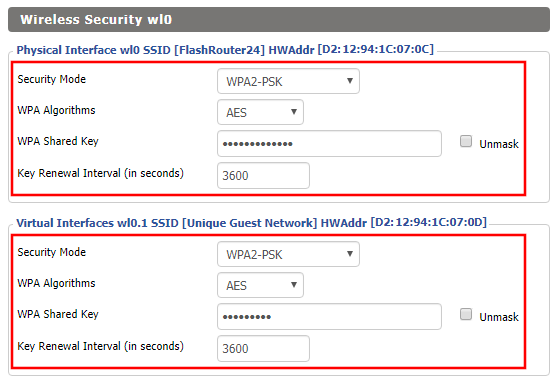
- Duplicate the wireless security settings that are set for the other bands for the newly created virtual interface.
- Click Apply Settings.
- Reboot your router.
Enable DHCP for Guest Network
Navigate to Setup > Networking
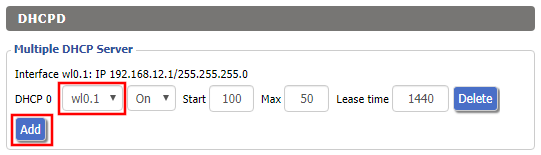
- Scroll to the very bottom of the page and under DHCPD click Add.
- Select wl0.1 or ath1.1 depending on your router model.
- Click Apply Settings.
- Reboot your router.
Depending on the router model and WiFi band you are using, the wireless interfaces will be labelled differently.
This setting can be labelled wl1.1, ath0.1, wl2.1, and so on. Make sure when you get up to the bridge assignment section that you are using the correct guest network Virtual Interface.
Back up your settings
Navigate to Administration > Backup
- Click the Backup button.
- A file named nvrambak.bin will be saved to your computer.
- You can load nvrambak.bin to restore your settings in the event of a reset.