- Visit ExpressVPN’s website login page
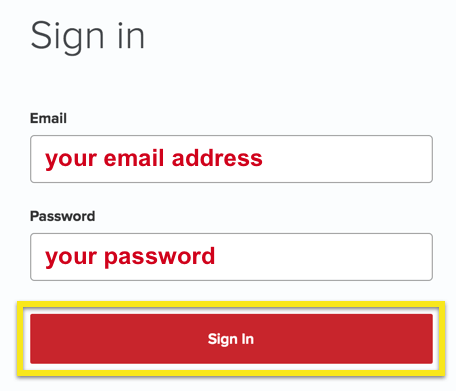
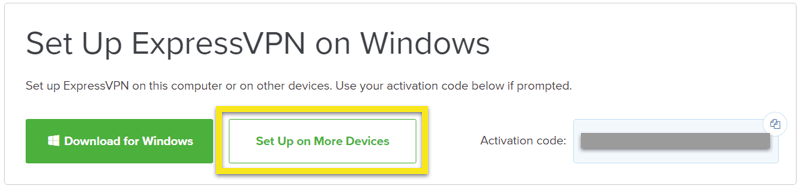
- Successfully log in with your account information. Select Setup on More Devices.
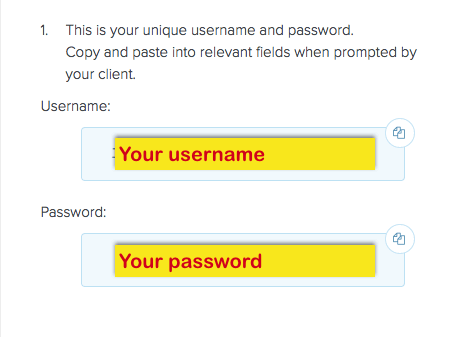
- Select Manual Config and copy the Username and Password that are displayed on the right hand side of the screen.
Search Results for: privacy app vpn
ProtonVPN Setup for GL.iNet Routers
You can connect to ProtonVPN on your GL.iNet router using Wireguard or OpenVPN.
Quick Options
-
Wireguard: Download your preferred server .conf configuration file from the ProtonVPN website.
-
OpenVPN: Download your preferred server .ovpn configuration file from the ProtonVPN website.
 If you are not already a ProtonVPN user Sign Up Now.
1. Login to your ProtonVPN account and go to the Downloads section of your ProtonVPN account page
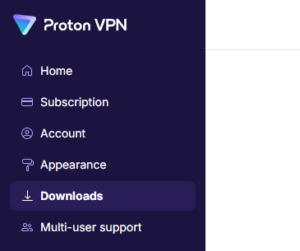
2. Scroll down to find the WireGuard configuration section. Name your configuration and then select Router as the platform, and select Standard server configs.
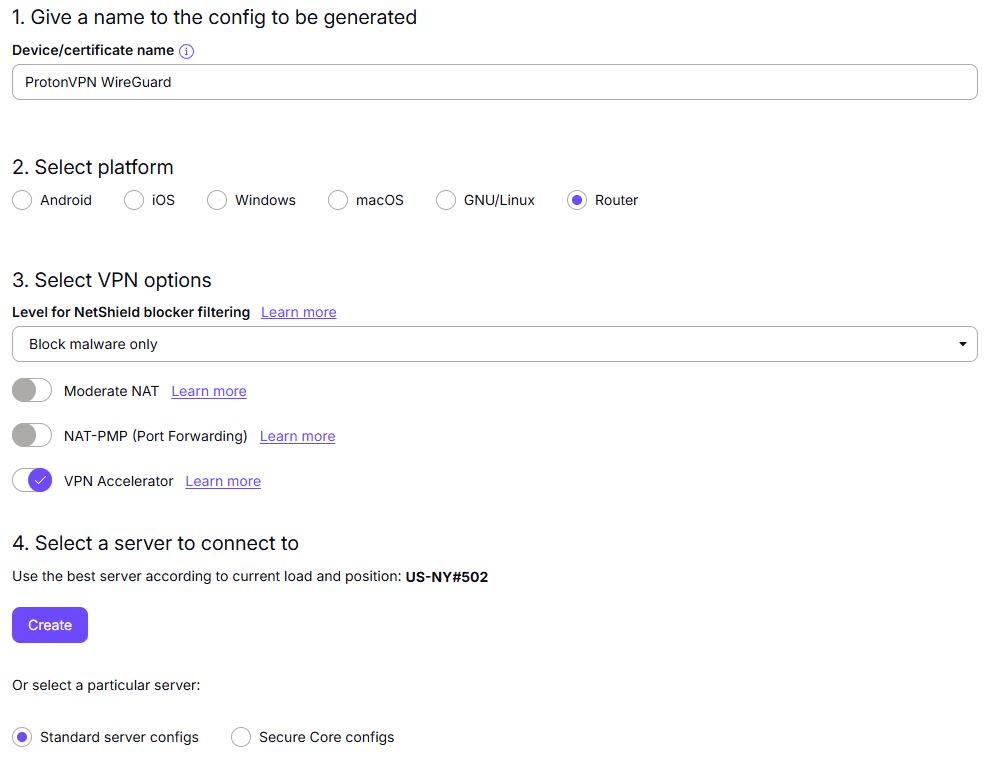
3. Click Create button to choose the recommended server or scroll down to choose and Download any of the available server files from the list.

4. Login to GL.iNet firmware settings (usually 192.168.8.1) in a browser on any computer or smart device connected to the GL.iNet FlashRouter’s network.
View our guide for more instructions on how to access GL.iNet firmware settings.
5. Navigate to the VPN tab and select WireGuard Client then click + New Group and name your connection and click the check to save.
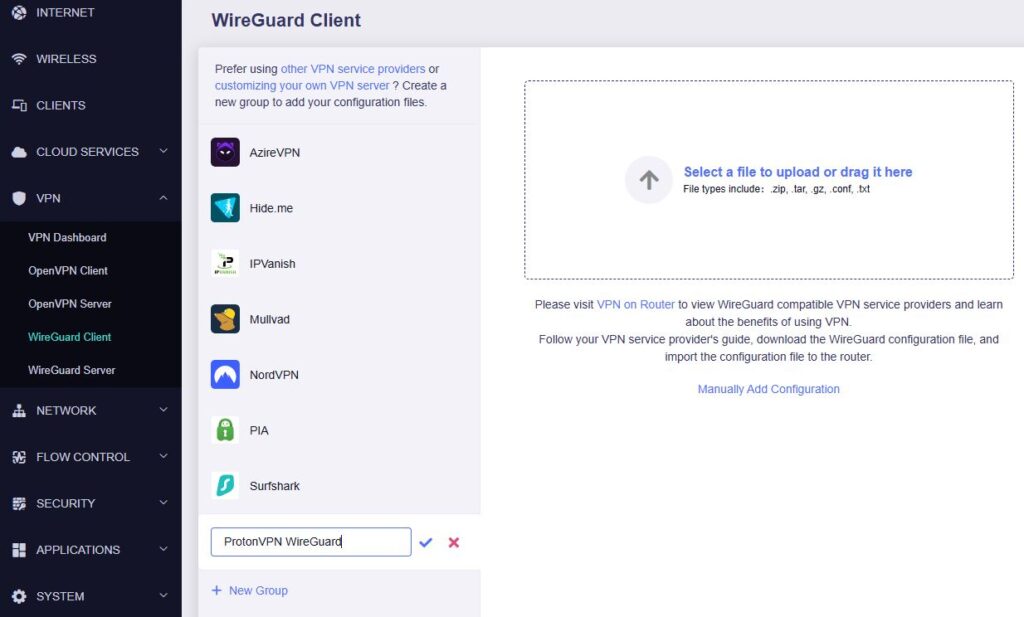
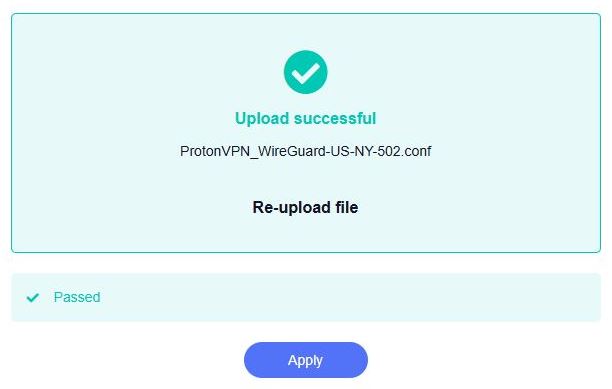
6. Upload the configuration file and click Apply.
7. Start a connection by clicking the 3 dots (…) > Start next to your chosen server.
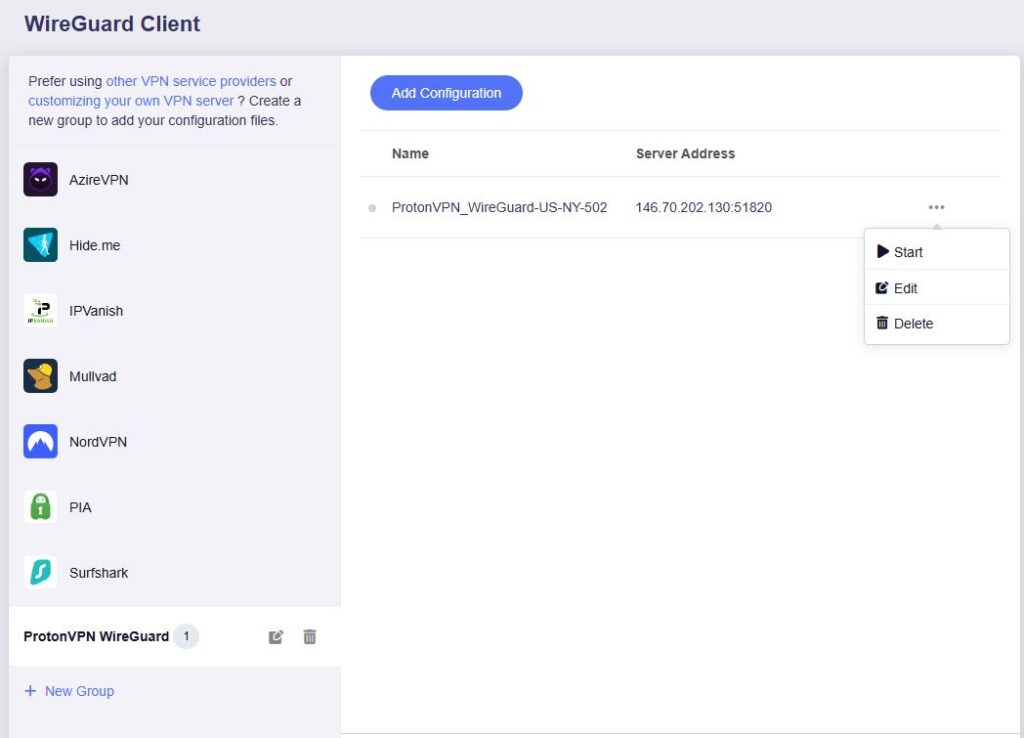
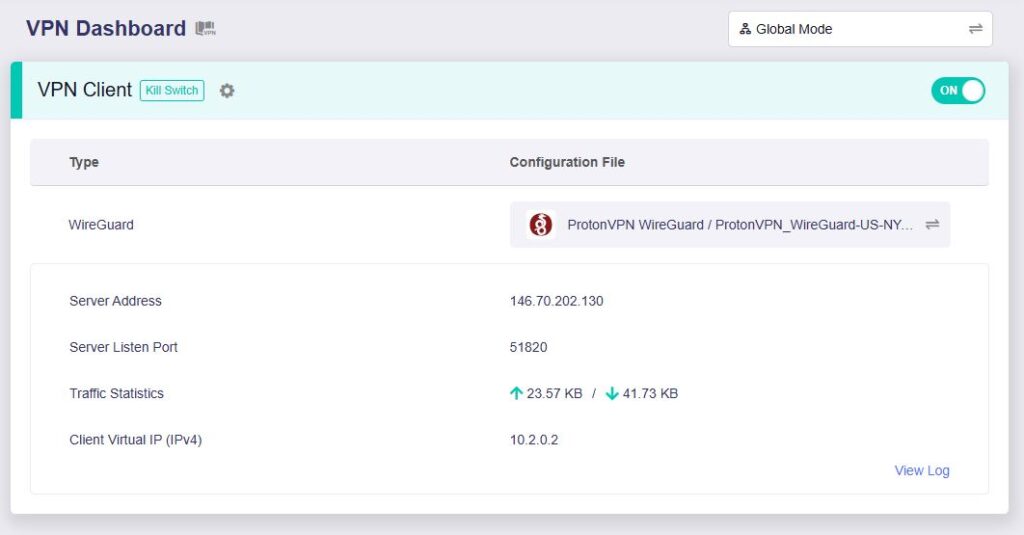
8. A green dot confirms success. You can also switch between Global Mode or Policy Mode for routing in the VPN Dashboard.
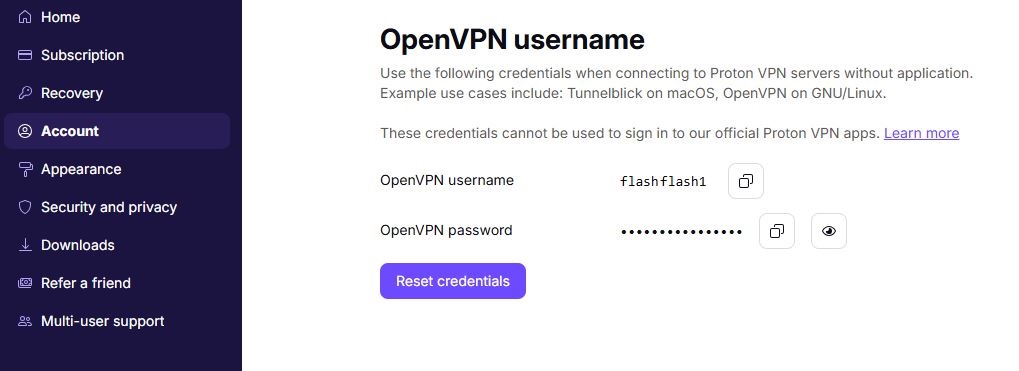
1. Log in to your ProtonVPN account and navigate to the Account tab. Scroll down to find your OpenVPN specific Username and Password.
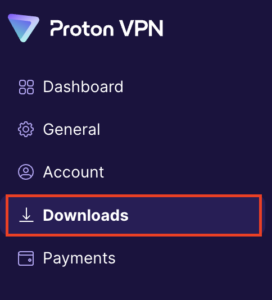
2. Go to the Downloads section of your ProtonVPN account page
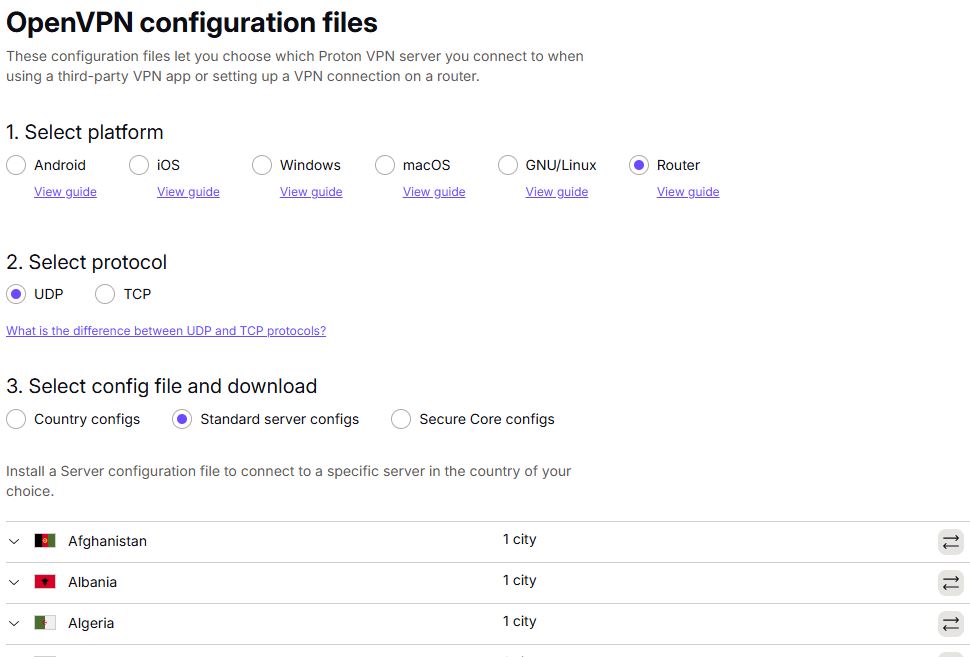
3. Scroll down to find the OpenVPN configuration Files. Select Router as the platform, UDP as the protocol, and select Standard server configs. Choose your preferred country and download the configuration file.
4. Login to GL.iNet firmware settings (usually 192.168.8.1) in a browser on any computer or smart device connected to the GL.iNet FlashRouter’s network.
View our guide for more instructions on how to access GL.iNet firmware settings.
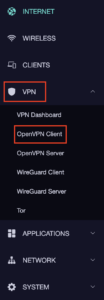
5. Navigate to the VPN tab and select OpenVPN Client.
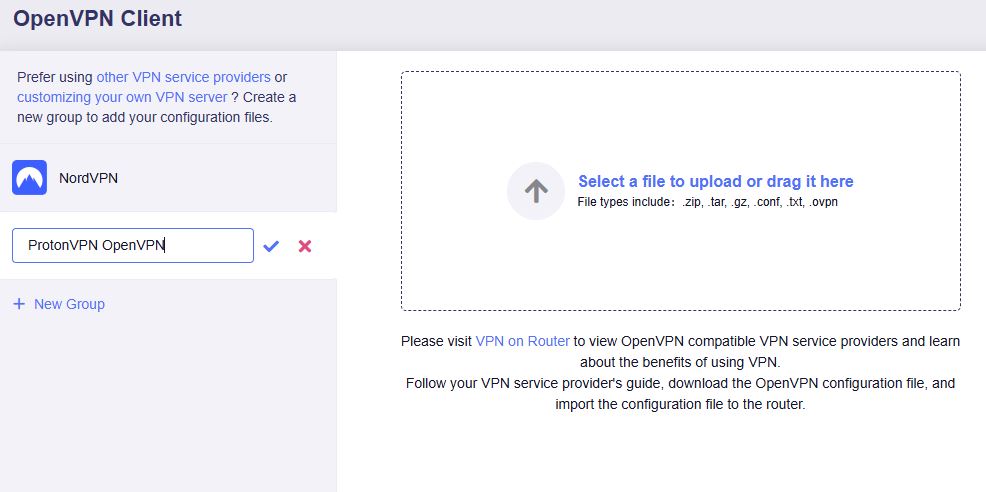
6. Select Add Manually then click + New Group and name your connection and click the check to save.
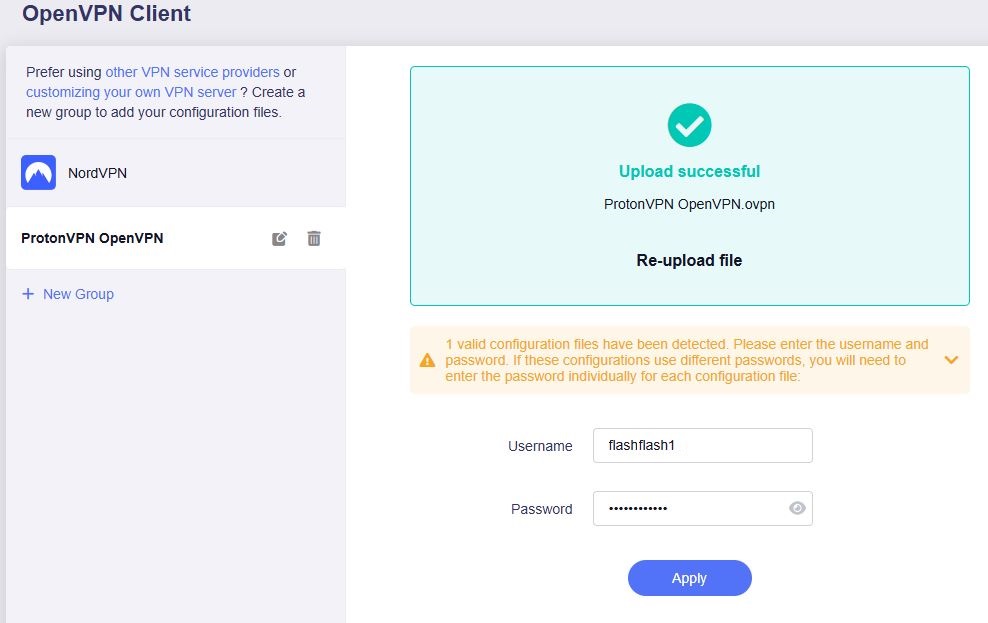
7. Upload the configuration file and input your username and password, click Apply.
8. Start a connection by clicking the 3 dots (…) > Start next to your chosen server.
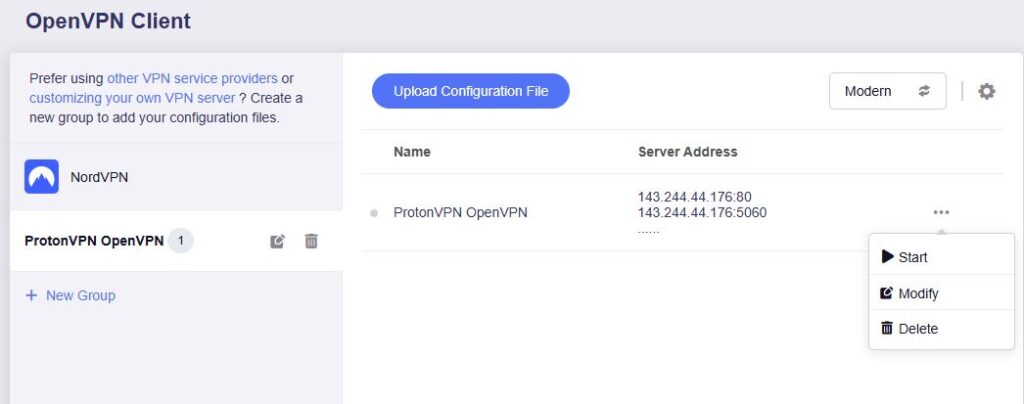
9. A green dot confirms success. You can also switch between Global Mode or Policy Mode for routing in the VPN Dashboard.
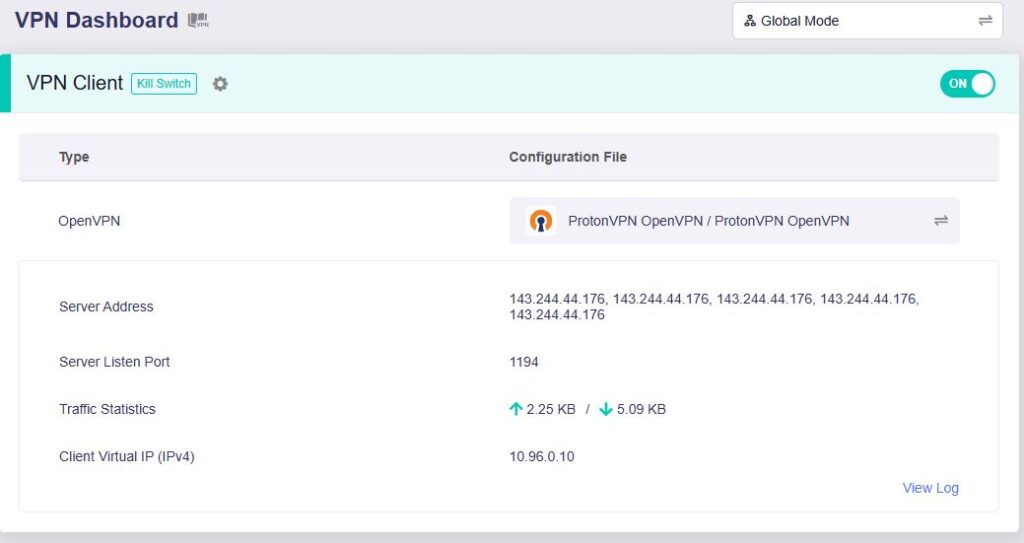
- You should now see information appear in the Server Address, Server Listen Port, Traffic Statistics, and Client Virtual IP areas.
- Visit ProtonVPN’s IP Check to verify your new IP address and virtual location.
In some cases you may notice that the location is not showing the same location as the server you have input in your router settings; this is because geo tracking tools are often tricked by VPN connections. As long as you see an IP address that is not the same as your normal Internet IP address then you are indeed connected to ProtonVPN.
🚫📱Do not run ProtonVPN apps on devices connected to your ProtonVPN router. Using the app at the same time as the router VPN may cause conflicts and connection issues.
Getting Started With Your FlashRouter
Getting Started With Your FlashRouter
Setting Up Your VPN Service
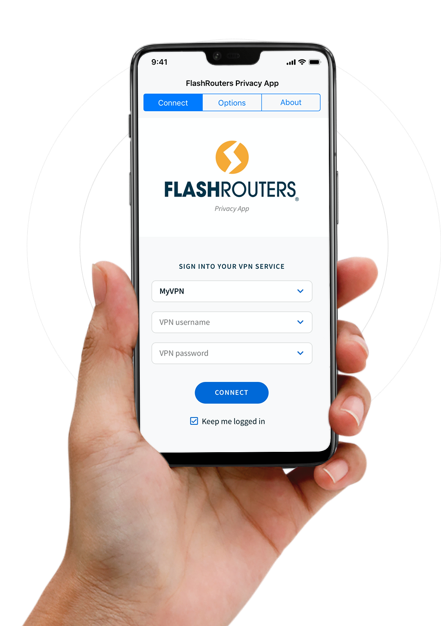
Select your operating system below to setup the FlashRouters Privacy App on your router, the easiest way to connect to the best VPN services. For ExpressVPN FlashRouter users, please view the following section for setting up the ExpressVPN app.

Why are some of my devices not connecting to the internet?
- Make sure you are not using any device VPN device application or proxy on devices that are connected to the FlashRouter’s network as this can cause a conflict. Make sure the FlashRouter’s VPN connection is the only active VPN connection in your network.
- Check that static settings are not configured on your device.
- Certain devices require port forwarding rules to be properly setup before full connectivity. This may apply to devices like VOIP or smart cameras. If this is the case you may need to contact the manufacturer for more specific information.
- Check that the FR Privacy App feature for a device specific Kill Switch is not set for the device, and if kill switch is setup, then make sure the VPN connection is active.
Access FlashRouter DD-WRT firmware settings
You must be connected to the FlashRouter network via ethernet or WiFi connection on your device in order to be able to access the FlashRouter’s firmware settings.
Why do I need to access my FlashRouter's settings?
- Switch VPN server locations
- Attempt custom setups
- Troubleshoot your network
Connect your device to the FlashRouter network
We recommend using a computer, tablet, or phone to access your FlashRouter firmware settings. You can connect your device to the FlashRouter via Ethernet Cable or Wireless connection.
Please note, you will NOT be able access the firmware settings unless you connect your device to the FlashRouter Network.
via Ethernet
Connect an Ethernet cable to your device’s Ethernet port.
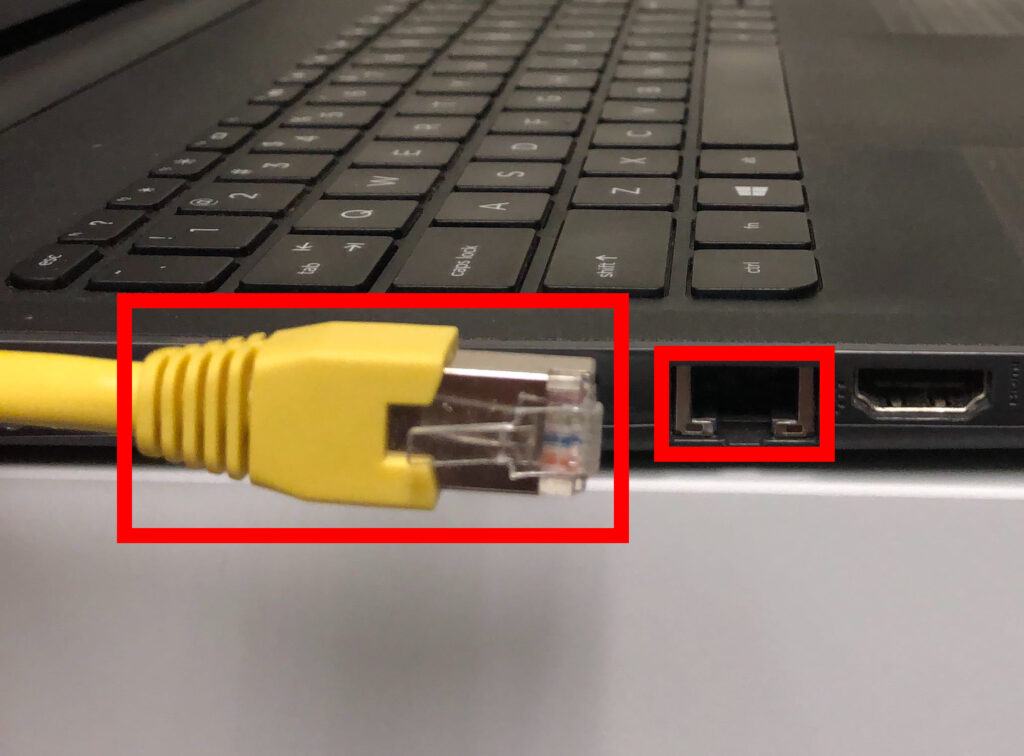
Connect the other end of that Ethernet cable to a FlashRouter LAN/numbered port.
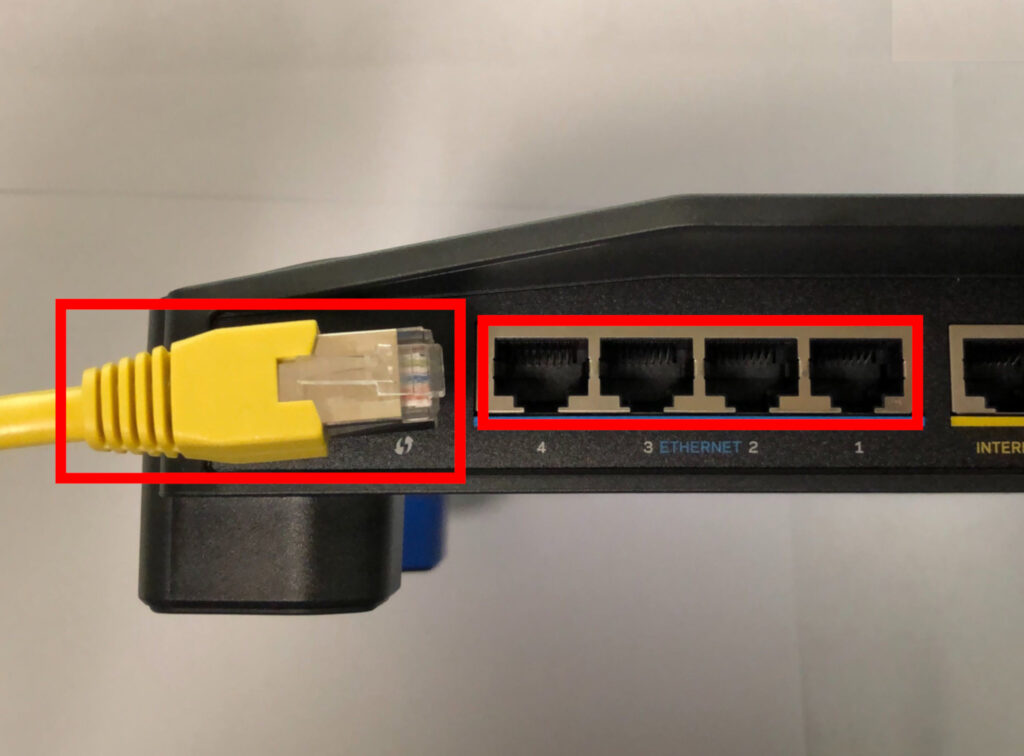
Be sure NOT to connect your device to the WAN/internet port of the FlashRouter. Please use the LAN/numbered ports to connect your devices.
via Wireless
Navigate to the available wireless networks in your device network settings and join any of the available FlashRouter networks – FlashRouter24, FlashRouter50, or FlashRouter80 (if you have a tri-band router).
Access the FlashRouter settings
We recommend using a Google Chrome or Mozilla Firefox incognito/private browsing window to access the FlashRouter firmware settings. You can access the main DD-WRT firmware GUI or you can go directly into the FlashRouters Privacy App settings to manage your basic router settings and VPN connection settings right away.
Please note, after accessing the FlashRouter Settings at the Local IP Address, you will be prompted to enter an admin username and password. You can find this information in the subsections below.
DD-WRT - Firmware GUI
Local IP Address: 192.168.11.1
Username: flashrouter
Password: ddwrt
Keep in mind that if you enable HTTPS and disable HTTP access you will need to add https:// in front of the Local IP Address to access your FlashRouter’s firmware settings.
If your router has been reset for any reason then you can access the router at a local IP address of 192.168.1.1.
Please note you will be required to set the administration username and password as well as your WiFi and VPN network settings after a reset.
Why is my router not connecting to internet?
Router not connecting to the internet? Follow these simple steps!
- Make sure that you are not setting a WAN IP of 0.0.0.0 in the top right corner of your FlashRouter DD-WRT settings. If you do, then make sure your FlashRouter is wired correctly for Internet.
- Try power cycling your ISP modem, FlashRouter and any other router that may be in the setup. Power the modem back on first, wait for it to boot up fully, and then power the FlashRouter back on.
- Make sure you do not have Global Kill Switch enabled in the FlashRouters Privacy App and if you do make sure your VPN status is Connected.